
If your AI appointment booking is not working, the voice is probably fine. The problem is usually quieter: a booking the caller heard confirmed that never reached the calendar your office actually uses. A smooth first minute can hide a lost next day.
Imagine you run a roofing business and are playing back the evening calls. The voice sounds helpful. People describe leaks and ask for inspections; the service takes their details and ends politely. In the morning, the office opens the list it actually uses to schedule visits. A request can be present in the phone dashboard but absent from that working list. You paid to answer the ringing phone, but the next step still depends on someone moving information between places and deciding who will call back.
This is the repair we scope through The Quiet Protocol's client intake systems: the call, usable record, appointment or review route, and person responsible for continuing. We configure approved questions and actions, connect the agreed destinations and test failures as well as successful calls. For standard phone coverage, the Essential AI voice agent plan is $449/month with 600 minutes of calls, free setup, no contract, with the AI Business OS included. Custom voice integrations and more complex call flows are scoped separately, from US$1,495 setup + US$997/month. Your written scope sets the usage allowance, connected systems and call paths we maintain after launch.
That is why I resist the question, “Did the AI work?” It collapses several jobs into one. The caller cares whether somebody helps with the roof. The business needs an accurate request, a responsible person, and a next step that happens. A nice conversation is only the opening chapter.
Start with the customer's last sentence
Take one recent call where the person asked for a quote, visit or callback. Listen to the end of it. What did the customer believe would happen? “Someone will call you” is a promise, even if the system never created a task. A booking confirmation is a bigger promise: the slot should exist on the calendar and the right person should know why the visit was booked.
Now walk into the office as the person who starts the next shift. Can they find the request without hunting through emails, texts and a phone dashboard? Can they tell which address matters, whether the customer has an active leak, what was promised, and when a response is due? If not, the call may have been answered but the job was never properly handed over.
Start with the caller's last expectation because it tells you what needs checking. If the service said an inspection was booked, verify the appointment in the working calendar, not only in the call transcript. If it said a person would return the call, look for an assigned task and the response itself. If it said the business could help with an urgent issue, check whether the request reached the approved urgent route. A polite ending can conceal a broken promise.
- 01The requestListen to the call
What did the caller actually need, and which words told you it was urgent or valuable?
- 02The recordOpen the working list
Can the team find the address, contact details, context and promise in the place they work?
- 03The ownerName the handoff
Which person is responsible for the next action, and who covers when that person is away?
- 04The finishClose the loop
Was the caller reached, booked, declined, or still waiting with a dated next step?
Keep the conversation record beside the business record. An ended call does not establish that an appointment exists, that its details match the caller's request or that staff accepted the next action. Those facts need to be checked where appointments and follow-up are actually managed.
When the appointment never appears, inspect this chain
A booking route needs more than permission to speak a time aloud. First establish whether the caller is eligible for that appointment: the requested service, location and any required human review. Then check the correct calendar, resource, duration, buffer and time zone. Next confirm that the action saved a single appointment with the corrected caller details. Finally compare the customer's confirmation and the receiving team's view with that saved record.
If a connection times out after a save, check for an existing appointment before trying again. Otherwise a retry may create a second booking. If availability or success is uncertain, the service should say the request needs confirmation and assign it to a person. “I have your request; our scheduler will confirm the time” must be backed by a real owner and an honest window.
Where did booking stop?
| Transition | Evidence to inspect | Repair if it fails |
|---|---|---|
| Request to eligible appointment | Caller's stated service and location match the approved appointment rules. | Correct the eligibility rule or route uncertain scope to a person. |
| Eligible appointment to real slot | Correct staff, duration, buffers, time zone and current availability. | Fix the calendar configuration; use an owned request while availability is uncertain. |
| Offered slot to saved record | One appointment exists with the final time and corrected contact details. | Inspect the failed action and existing record before retrying. |
| Saved record to customer confirmation | The customer heard or received the same service, date, time and next step. | Correct the message and contact route; tell the customer what is actually confirmed. |
| Confirmation to staff ownership | The receiving team sees the appointment and its purpose; an exception has an owner. | Fix the destination, permissions or acceptance rule and verify the next action. |
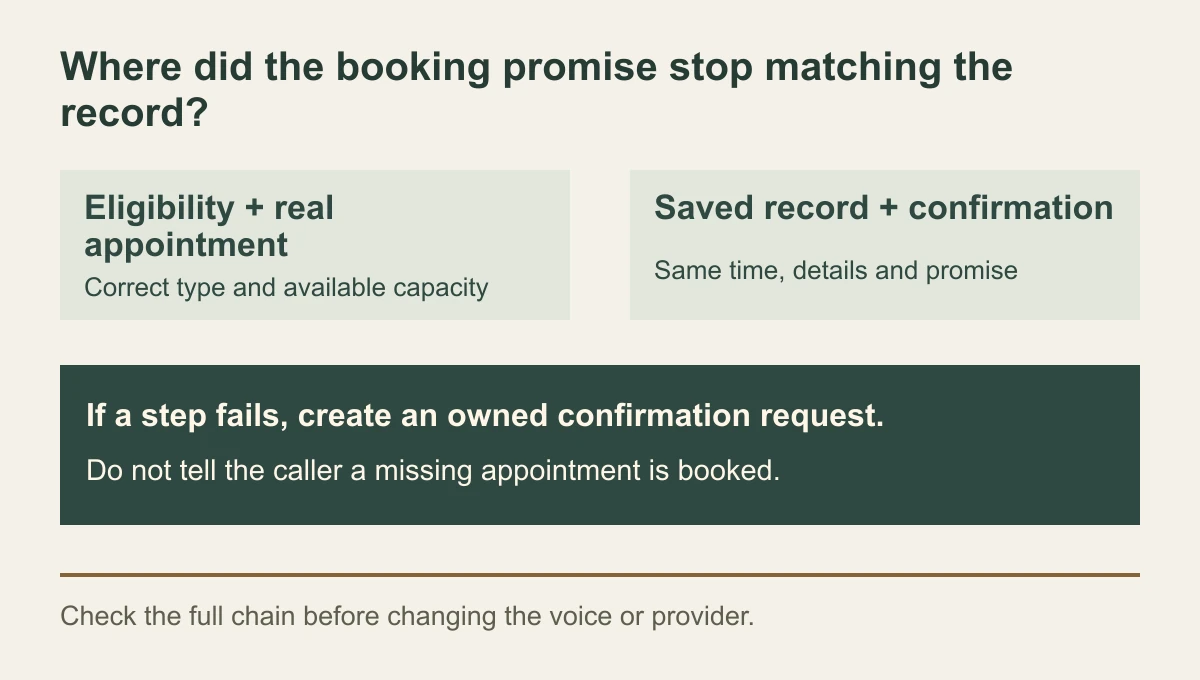
Find the first break, not a culprit
Sometimes the AI is the problem. It may mishear an address, answer a question it does not know, talk over a worried caller, or promise an appointment the calendar cannot honor. Listen for that first. A broken conversation needs different work from a broken handoff.
Sometimes the conversation is fine and the office never receives a usable record. Perhaps the summary goes to an inbox nobody opens, or the caller's corrected number remains in the transcript but not the contact record. A notification is not a working process. It has to arrive where the next person makes decisions.
And sometimes every record is present, but nobody owns the response. The same failure can happen with a human reception desk. Three people can see an inquiry and each assume one of the others called. The solution is ordinary: a named owner, a due time, a fallback, and a way to show that the customer got an answer. Software can carry the rule. It cannot invent the rule for the business.
Separate five different failures
I would put each disappointing call into the first category that broke, rather than giving the whole installation one verdict.
- Conversation: the service misunderstood the caller, missed a correction or failed to let them reach a person. Listen to the recording and check the facts the caller actually confirmed.
- Permission: it answered beyond the business's rules, quoted an unapproved price or treated an uncertain request as a firm booking. Tighten the allowed actions and the stop point.
- Delivery: it captured a good request but sent it to the wrong inbox, a disconnected calendar or a dashboard staff rarely open. Repair where the record lands.
- Ownership: the right team saw the record, but no person was responsible for the callback, inspection or exception. Name the owner and backup.
- Closure: somebody acted, but the outcome was not recorded and the customer did not get a clear answer. Make the finish visible to the next shift.
One request can have more than one flaw. Fix the earliest break first. A beautifully written follow-up message cannot rescue an incorrect address that never reached the dispatcher. A new voice model will not solve a quote request that sits unowned in an inbox.
The category also tells you what to ask the vendor. A conversation failure calls for better questions, transfer behavior or a different product. A delivery failure calls for a working connection and proof that the record arrived. An ownership failure is the business's decision, even if the vendor can help configure the handoff. Keeping those jobs distinct prevents another purchase from inheriting the same broken route.
Repair the smallest broken part
If the voice misunderstood callers, tighten the questions and the human escape route. Let it ask for an address again, but do not trap someone in a loop. If it promised the wrong service or price, restrict it to approved answers and let a person handle the rest.
If records are missing, connect the call to the team's real working list and check that corrections survive the transfer. If work is unowned, decide who gets each kind of inquiry before adding another alert. If follow-up is late, set a response promise the team can keep, including evenings and weekends. A caller who needs help tonight should not hear “right away” when the next real callback is tomorrow.
The owner in this example needs the receiving process to work. They need to know which requests reached the office and what the office did with them. That makes the next decision clearer: fix the route, test it with real calls, and judge the whole customer path.
Recover the open requests before rebuilding the system
When a setup has failed, there may already be callers waiting. I would begin by finding the recent requests the business has not resolved. Compare the phone log with the working calendar or customer list, using the access and privacy rules the business already has. Identify people who were promised a callback or visit. Give each record an owner and a truthful next contact. Do this before spending a week redesigning the greeting.
Then pause any promise the system cannot currently keep. If the booking connection is unreliable, let the service collect the request and tell the caller when a person will confirm availability. If an urgent transfer is failing, use the business's approved backup route or stop presenting that route as live. A narrower truthful service gives the office a request it can own while the affected action is being repaired. NIST's voluntary AI Risk Management Framework describes ongoing testing, monitoring and deactivation when a system behaves outside its intended use. Applying that principle here means pausing the failed booking action, keeping a human route and verifying the repair.
I would test one repaired path end to end. Make the call, inspect the record in the team's real workspace, have the responsible person accept it, and check the message or booking the caller receives. Then test a correction, a cancellation and a request outside the script. The service is ready to regain responsibility only when those paths work without someone secretly fixing them behind the scenes.
Keep a record that answers your question
You do not need a wall of call analytics. You need to know which customer requests have no outcome. A useful review record can be short: when the call came in, what the person wanted, what the service promised, where the request landed, who accepted it, and what the business did next. A status such as “completed call” belongs in that record, but it is only the first event.
I would take calls from different conditions: an ordinary business-hours inquiry, a busy-hour overflow, an after-hours request, a caller who corrected a detail, and a person who asked for a human. That spread matters more than selecting only the calls where the voice sounded polished. Read the working list alongside the recordings. If a callback was made but the record still says “new,” repair the record. If a record says “booked” but the calendar has no visit, repair the booking path.
Pay special attention to the promise the caller heard. “We will pass this on” is different from “a technician will call tonight.” The second requires a real tonight owner. If the business cannot support that promise, the answer should change, even if the AI said it perfectly. The review is not a contest to make the transcript sound better; it is a check that the business can do what it told the customer.
If the same person calls twice, connect the second call to the open request. Otherwise the dashboard may count two answered calls while the customer experiences one unresolved problem.
After each review, choose one repair and assign it. The vendor may need to change a question or connection. The office may need to name the next-shift owner. The dispatcher may need a clearer urgent route. Mark the next real call that should test that repair, then inspect what happened. A list of defects without a person to close them is another version of the original failure.
Should I replace the AI answering service?
First locate the break. Replace or retrain a system that cannot handle your calls safely. Repair a missing handoff or unclear office responsibility even if you change providers, or the new service may inherit the same failure.
I would replace the provider when it cannot meet a necessary boundary after a reasonable test: it cannot stop making an unapproved promise, cannot transfer a caller who needs a person, cannot deliver a reliable record, or gives the business no way to inspect and correct errors. If the calls are accurate but staff do not act on them, the provider switch is unlikely to fix the central problem. Repair the operating route and keep the option to change tools open.
What should I measure besides answered calls?
Look at usable requests, accurate bookings, overdue callbacks, failed transfers and unresolved inquiries. Review what the caller heard alongside what the team actually did. A high answer rate alone cannot tell you whether customers were helped.
Can the AI handle follow-up by itself?
It can send an approved message or reminder, but a person still needs to own replies, exceptions and complaints. Follow-up is a conversation with a customer, not a message count.
If you have not launched yet, use the pre-launch receptionist field test before customers become the test group. For an existing failure, bring one safely redacted request to our client intake systems team. We trace the promise, calendar, record and responsible person, then scope the repair and the continuing responsibility around the part that broke.
Frequently asked questions
Why might an AI receptionist answer calls but fail to book?
The break can be in service rules, available times, the calendar write or the receiving handoff. Find the first point where the caller's promise and the actual record disagree before replacing the whole system.
Should the business change the AI voice to fix booking?
A different voice cannot repair an unavailable slot, a disconnected calendar or a missing owner. Inspect the route and correct the specific failure first.
How can TQP improve an unsuccessful AI answering setup?
We trace the intended customer path and design the approved repair, including records, calendar rules and exceptions. Recover open requests with a named owner while the system is corrected, then test the complete route again.
We trace the request, calendar, record and responsible person, then scope the connections and handoffs that need repair. The work should address the first broken transition.
Repair the intake path behind the answered call