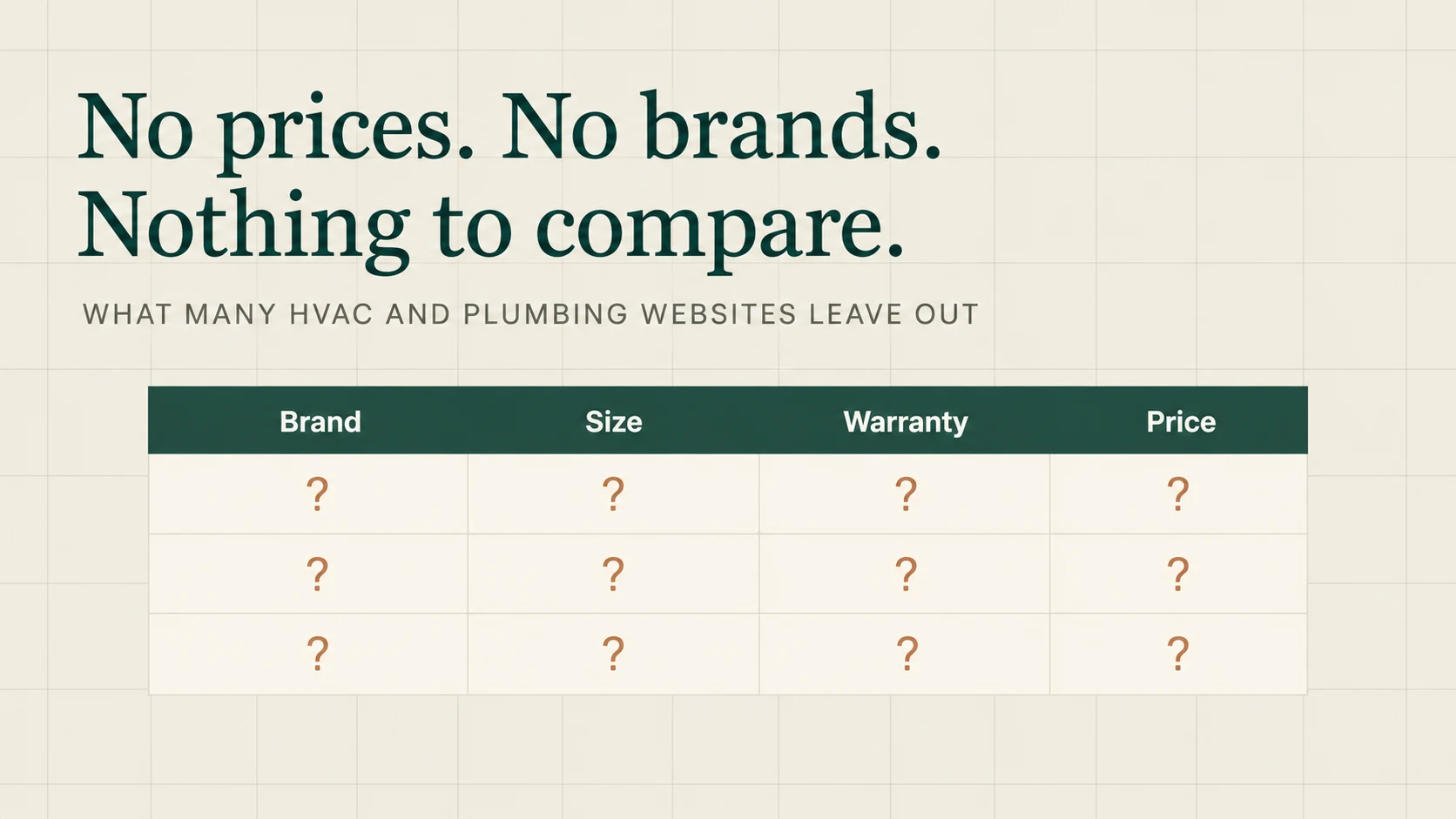
It is July. Your air conditioner just died. It is 10pm, the kitchen is stifling, and you open three tabs.
Company one has a nice photo of a van. Company two has a phone number. Company three has a form that says "Contact us."
You wanted to know three things. What will this cost? Which brands do you put in? How are you different from the next company?
Not one of the three tells you.
I look at a lot of HVAC and plumbing websites, and I speak to the people who own them. A lot of them have the same problems. Here is what I see, and what to do about it.
What I see on these websites
I am not auditing a list here. This is what keeps turning up, in my own work, over and over.
No prices. Not even a range. Not even "from."
No brands. A customer cannot tell which makers you install and which you do not.
No comparison. Even where there is some information, there is no chart that lines options up side by side.
Not built to be found. A lot of these sites ignore search, and ignore what people now ask ChatGPT and Google's AI answers too.
Nothing behind them. No CRM, so no record of the leads that came in.
These are call-dependent businesses. The phone is the business. Yet the website, which should be sending people to that phone, often does very little.
"What does a 1 ton AC cost?" and nobody tells you
Let me give you the customer's side, because owners rarely see it.
Say you want a new system. You want to know what a 1 ton unit costs and which five brands the company works with. Without that, you have nothing to compare.
So you do what everyone does. You search Google. You ask ChatGPT. You open five more tabs.
By the time you are done, you cannot remember which company said what. Was it the one with the blue van? The one who answered the phone?
You did not decide. You got tired.
And a tired customer does not choose the company that made her work for it. She picks whoever answers first, or whoever she remembers.
The fix is not fancy: a comparison chart
If you want to be remembered, give people something to compare. A simple chart does it.
Here is the shape. Fill it with your real numbers.
A comparison chart you can put on your site
- Brand
- Each make you install, listed by name.
- Size
- The system sizes you offer, so a customer can match their home.
- Efficiency
- The rating, in plain words, and what it means for the bill.
- Warranty
- Parts and labour, separately, and for how long.
- Installed price
- A range, from and to. Say what it includes.
- Good for
- One line: a small home, a large home, a tight budget, a long-term home.
Put your own numbers in each row. A range is fine. A blank is not.
I am not giving you prices on purpose. Your costs are your costs. The point is that your customer sees them.
Will some customers use your price to shop around? Yes. They are doing it anyway. The difference is whether they do it with your numbers or without.
Why this matters for ChatGPT and Google's AI answers
You may have heard two new words: AEO and GEO.
AEO is answer engine optimization. GEO is generative engine optimization. In plain English, both mean the same thing: make it easy for tools like ChatGPT and Google's AI answers to find a clear answer on your website.
Here is my read of it. I cannot promise any website will be quoted. Nobody can.
But think about how an AI answer is built. It needs facts to work with. Prices. Brands. Warranties. Your service area. Your hours. How booking works.
A website with a banner and "Call us today" gives it nothing to quote. A website with a clear chart and honest answers gives it plenty.
If you want the basics of this, we wrote how to get found on ChatGPT. For the local side, local SEO for HVAC contractors is a good start.
Then there is the phone
A great website still ends at a phone call.
And as I wrote in who picks up after 6pm, a lot of those calls do not get answered. A website that sends a customer to a phone that rings out is a very expensive brochure.
So put a booking link or a request form next to the phone number. Let the customer do something at 10pm without waiting for you.
And then there is nothing to remember it by
Here is the part owners miss. Every lead that comes in, from the website, the phone or a text, should leave a record.
Many of these businesses have no CRM. So when somebody asks for a quote and disappears, nobody knows. Nobody follows up. The lead was real, and now it is gone.
A CRM does not have to be complicated. It is a list of who asked, what they wanted and what happened next.
A weekend checklist
Here is what you can fix in a weekend. No agency required.
- Add a price range for your main jobs. "From" and "to".
- List the brands you install, by name.
- Add one comparison chart like the one above.
- Say where you work and when you answer, including emergencies.
- Put a booking link or request form next to the phone number.
- Write real answers to the five questions customers ask you most, in plain words.
- Say what happens next after someone books. People like knowing.
- Keep a record of every enquiry in one place.
Do two of these and you are ahead of many of the sites I see.
Here is how we help
If you would rather not spend the weekend, this is what we do.
Our Smart Websites are built around the customer's questions, with the booking and follow-up built behind the page. We lay out your prices and brands with you.
If you need a simpler site, the Essential Website is $99/month for hosting and care, free design and build, with hosting, SSL and routine updates.
For being found, our local search work takes care of your listings and profile.
And for the phone, our AI receptionist answers every call at any hour, answers your common questions, books the visit and records the call, with the AI Business OS as a bonus. The OS starts at $497 a month on its own and has a CRM and job pipeline, so every lead leaves a record.
Your website, your phone and your records. One place.
Common questions about HVAC and plumbing websites
What should an HVAC website include?
Your services, your service area and hours, the brands you install, a price range for your main jobs, a comparison chart, real answers to common questions, a booking link or request form and a visible phone number. It should also say what happens after someone books.
Should an HVAC company show prices on its website?
I think yes, at least a range. Customers compare, and they cannot compare what you hide. A range with a note about what it includes gives people something to remember you by.
How do I get my HVAC company to show up in ChatGPT?
Nobody can guarantee it. What you can do is make your facts easy to read: prices, brands, warranties, service area, hours and how booking works, in plain text on your pages. Keep your business details consistent everywhere they appear.
What is the difference between AEO and GEO?
Both describe making your content easy for AI tools to use. AEO is answer engine optimization, focused on giving clear direct answers. GEO is generative engine optimization, focused on being a source in AI-written answers. In practice, the work overlaps.
Do plumbing websites need the same things?
Yes. Plumbers can show price ranges for common jobs, the brands of fixtures and water heaters they install, their service area, emergency hours and a booking link. The same gaps show up on plumbing websites.
If your website makes people work, see how our Smart Websites do it differently.
A website built to answer the questions customers ask, take the booking and keep a record of every lead.
See our Smart Websites