
Accounting client management software earns its place when your next inquiry has a clear owner and an obvious next conversation. Start by asking what help the person wants, what timing matters and who should review the request. Then check that the answer survives a busy week.
Imagine a business owner calling about monthly bookkeeping. The receptionist passes the call to a partner, who discovers that the books are several months behind. Another colleague handles cleanup. The owner explains the situation again.
Everyone was helpful. Everyone was also doing a little work that could have been avoided.
I would fix the handoff before adding more questions. The firm needs enough information to choose the next person, and that person needs to know what has already been said. A longer form will not achieve either if its answers sit in an inbox nobody owns.
I recommend TQP’s Client Intake & Booking System for a firm that wants this handoff to work as a connected process. Popular Solo + AI tools: US$299/month total (regular US$399). Solo Professional: US$199/month. Professional/Premium setup waived (US$3,300/US$5,500). Subscribe by December 31, 2026; monthly rate locked. The system includes a professional website, an intake portal, branded calendars, a unified inbox and standard follow-up. Calls, texts, email and payment usage are separate. We give the client-facing work a structure your team can use, alongside the professional tools it already relies on.
Follow one inquiry all the way through
Consider an illustrative prospect: a consultant changing accounting firms. They want monthly books and say the last completed period was several months ago. They would like to start before a lender meeting next month.
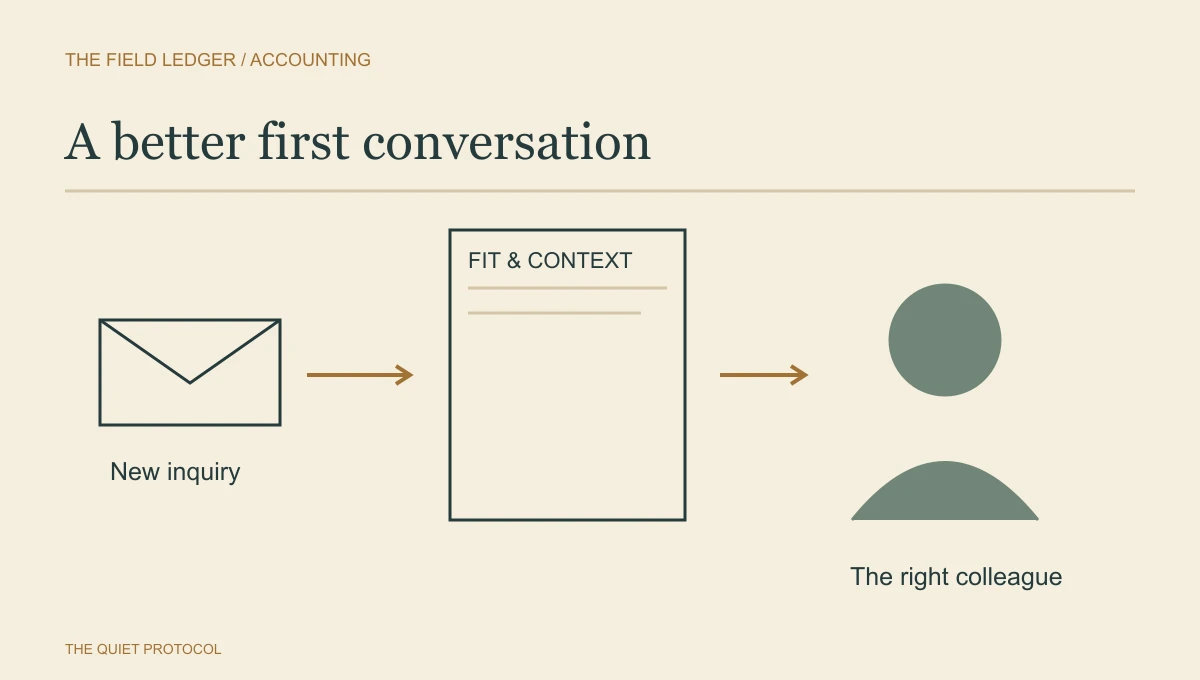
The first responder does not need to diagnose the books. They need to preserve those three facts: recurring work requested, possible historical work, an upcoming event. Then they can use the firm's approved rule to send the inquiry to the person who scopes bookkeeping and cleanup.
That colleague reviews fit and current capacity before offering a meeting. The partner can join later if a professional question needs their judgment. The lender meeting is recorded as the prospect's timing concern, not a deadline the firm has accepted.
If the same owner follows up by phone after submitting a form, attach the call to the original inquiry. Creating a second record gives two people permission to send two different answers. Quite an efficient way to become confusing.
This is why I prefer one place for the client relationship. TQP’s contact records, pipeline and unified inbox let the team work from the recorded request and the next action. We implement the questions, booking choices and follow-up around your firm’s approved routes, using established technology. You buy the connected handoff and the work of making it usable, rather than another login that your coordinator has to reconcile.
- First responder: Record the request, possible backlog and reason timing matters. Confirm the preferred contact route.
- Bookkeeping lead: Check service fit and capacity. Decide whether to offer a scoping call or explain a different next step.
- Assigned professional: Read the brief before the call. Review any accounting or tax question that intake could not decide.
- Coordinator: Send the agreed response and track it until the inquiry is booked, declined, waiting or closed.
If the bookkeeping lead is away, a named backup takes the review. The inquiry does not become everybody's responsibility.
Decide what reaches a partner
There are good reasons to involve a partner early: a referral seeking a complex advisory relationship, a matter outside the team's approved screening rules, or a question requiring a professional decision. There are also calls that do not need a partner at all.
| What the person is asking | First useful step | What the desk should avoid |
|---|---|---|
| “Do you take new monthly bookkeeping clients?” | Capture the basic need and send it to the person reviewing new work. | Promising a start date before capacity review. |
| “Did you receive the document I sent?” | Use the existing-client verification process and check the approved receipt record. | Starting a new-client form or saying the file is complete. |
| “I can't get into the portal.” | Put them with the person handling access help. | Asking for their password. |
| “Can you advise me before this transaction?” | Record the stated event and timing; alert the approved professional reviewer. | Giving an answer from a general intake script. |
| “I only need a service you don't offer.” | Give an accurate, respectful response under the firm's policy. | Reserving senior time to discover the same mismatch. |
Agree on these routes with the people receiving the work. A receptionist should not have to infer your acceptance policy from which partner looks least busy.
Keep the first questions small
Start with the person's name, contact route, whether they are an existing client, their request in plain words, general business or household context, and the timing they believe matters. Ask about a referral or current adviser when it changes preparation. Leave a way to say “I'm not sure.”
For bookkeeping, the pre-call form guide goes deeper into the questions that distinguish recurring work from cleanup. You do not need to impose that whole list on someone asking about a personal return.
The W3C forms guidance recommends collecting only information required for the process, with clear instructions and completion feedback. My practical version is simple: if a different answer changes nothing about the next step, consider asking later.
Keep sensitive documents, identity numbers and account credentials out of the public inquiry form. For U.S. tax practices, the IRS client-data guidance points to security plans and Publication 4557. Use the firm's approved document channel when a reviewer actually needs records. Sending a prospect a file-upload link should be a deliberate step, not the form's default appetite.
Give the reviewer a brief, not a transcript
A transcript can help resolve a disputed detail. It is a poor substitute for a note that prepares the next conversation.
Copy this outline into your inquiry record:
REQUEST: What the person wants, in their own words.
CONTEXT: General business/household type and relevant service location.
TIMING: Date or event the person mentioned. Not yet accepted by the firm.
KNOWN: Answers that changed the route or preparation.
UNKNOWN: What still needs clarification or professional review.
PROMISE: What we told the person would happen next, and by when.
REVIEW OWNER: Who is deciding the next step; backup if unavailable.
For the consultant, an example brief might say:
Wants monthly bookkeeping after changing firms. Says the last completed period was several months ago and has a lender meeting next month. Historical work has not been assessed. Bookkeeping lead to review fit and timing before offering a call. No start date or engagement promised.
That is useful because it distinguishes what the caller said from what the firm has decided. “Urgent cleanup client” quietly turns three unverified words into an accepted job.
Write replies for the decision you can actually make
An acknowledgment tells the person you received the inquiry. It should also explain the next decision and when they can expect it. Choose a response window your team can honour, then put that commitment somewhere visible.
For a request under review:
Thank you for telling us what you need. Our new-client coordinator will review the service and timing you described, then contact you through your preferred channel by [firm-approved response time]. We have not yet agreed to undertake the work or meet the date you mentioned. Please do not send financial documents by replying to this message.
If the firm cannot offer the service, say so. If you have a waitlist, explain what joining it means and whether another provider may be a more practical choice. Silence is a particularly unhelpful form of selectivity.
Once a call is appropriate, identify its purpose and who will attend. The bookkeeping discovery-call guide can help that person move from basic facts to fit and scope.
Make the handoff work before putting it in front of clients
Take a recent inquiry, protect the private details, and ask the team to reconstruct it. What was requested? Who accepted the next action? What did the person hear? Where did they have to repeat themselves?
Then try three ordinary situations: the reviewer is away, a caller follows up through a second channel, and an existing client uses the new-client form. If staff can handle those with one record and a clear next step, your foundation is useful. If they cannot, changing the form's colour is unlikely to help.
My recommendation is to put that route into TQP’s accounting client system. Bring an inquiry your team keeps having to rescue and the rules for who should receive it. We shape the website and intake path, set up the booking and follow-up, and test the ordinary handoffs before launch. A partner should join because the conversation needs their judgment, not because the firm has nowhere else to put a new caller.
Frequently asked questions
What belongs in an accounting firm's first client intake?
Collect the service needed, business context, relevant period, timing and a usable contact route. Ask only what changes the next decision. Sensitive documents and detailed professional review belong in the firm's approved later process.
Can intake automation decide whether to accept a client?
It can collect and route an approved brief, but the firm must decide who accepts the work and makes professional judgments. Make that review visible before offering a consultation or an engagement promise.
Why buy TQP's Client Intake & Booking System?
We design the questions, review route, booking choices and follow-up together. A submitted form becomes work a named person can carry, with the context already attached. That is the difference between collecting inquiries and operating a client intake system.
Your next busy season.
Better connected.
Your website, intake, booking and reminders, designed and configured together for your firm.
Subscribe by . Setup waived. Your chosen monthly plan rate stays locked into the new year.
Professional website
Up to 10 core pages plus 5 supporting pages, including privacy, terms and other utility pages.
Premium website upgrade
20 to 30 pages with bespoke high-end design and on-site SEO, AEO and GEO optimization.
Solo Premium + AI tools: US$399/month total.
Client-system bonuses: documents, proposals, unlimited e-signing, invoices and payment links.
Free 30 minutes. Bring your website, team size and current software. AI tools help with content and review replies. AI answering, conversational AI, tax preparation and custom integrations are separate. Usage charges remain payable.
Connect the website, inquiry record, booking and follow-up in TQP’s Client Intake & Booking System, with a professional website included.
Build your accounting firm’s first-client handoff