
Your bookkeeping intake form should answer one question before you pick up the phone: is this prospect a fit, and what are we walking into? Keep only the questions that change that answer, and save sensitive records for your firm's approved later process.
I would not begin with a forty-question questionnaire. A prospect trying to work out whether you can help should not have to complete the equivalent of their first month of bookkeeping before you reply.
A name and “How can we help?” can be too little. Every possible onboarding field is too much. The useful middle prepares the conversation without pretending to finish it.
I would put that form into TQP’s Client Intake & Booking System. Popular Solo + AI tools: US$299/month total (regular US$399). Solo Professional: US$199/month. Professional/Premium setup waived (US$3,300/US$5,500). Subscribe by December 31, 2026; monthly rate locked. It includes a professional website, an intake portal, contact records, branded booking and standard follow-up; communications and payment usage are separate. We connect the questions to the next conversation, so buying the form also gives your colleague a usable record and a route to the right appointment.
Separate monthly work from historical work
The biggest early distinction is often whether the prospect wants ongoing books, historical cleanup or both. Those choices change what the firm needs to investigate before quoting or promising a start.
Use language the prospect can recognise:
- Ongoing monthly bookkeeping.
- Bringing past months up to date.
- Both past work and ongoing bookkeeping.
- Not sure; I would like help choosing the next step.
“Not sure” deserves a real route. A person who knows their books are messy may not know when they last became reliable. Asking them to certify the last completed reconciliation can produce a very tidy guess.
Keep their own explanation beside the choice. “I need something I can show the bank” tells the person receiving the inquiry more than a service code does.
A short form you can adapt
The draft below is a starting aid for a bookkeeping firm's first inquiry. It is not a document-collection or engagement form. Adjust the choices to your actual services and decide which fields are required.
| Client-facing question | Suggested answer format | Why ask now? |
|---|---|---|
| What is your name, business name and preferred contact route? | Name and business name; email or phone with the relevant contact detail. | Reach the right person without requiring an unnecessary second channel. |
| What would you like help with? | Monthly work, past periods, both or not sure; short explanation. | Select the right first conversation. |
| What does the business do, and where is it based? | Plain description and general location. | Check whether the firm serves that kind of work and location. |
| Is this for one business or more than one? | One, more than one or not sure. | Flag scope that may need a different reviewer. |
| Which bookkeeping software do you use? | Firm-relevant choices, another system, none or not sure. | Prepare for supported software or a transition discussion. |
| How current do you believe the books are? | Up to date, behind by a stated period or not sure. | Recognise possible historical work without diagnosing it. |
| Is there a date or business event we should know about? | Optional date/event and reason. | Review timing without promising the firm can meet it. |
| Who will join the conversation and decide about the work? | Optional name/role or short explanation. | Invite the people needed for a useful next decision. |
You can copy the questions without the explanatory column into your own form. Put an instruction above them:
Tell us enough to prepare a first conversation. Please do not include passwords, identity numbers, account numbers or financial documents here. If we need records later, we will give you our approved transfer instructions. Submitting this form does not create an engagement or confirm a start date.
Do not force a phone number when the firm can handle the first response by email. If a call is essential to your route, explain why.
Ask one extra question when it truly changes scope
Some firms need an early signal about payroll, inventory, payment processors or transaction complexity. Others do not provide those services. The same form should not pretend to be ideal for both.
If payroll determines who handles the call, ask whether the business has employees and who currently handles payroll. If ecommerce determines fit, ask whether sales happen through online platforms. Keep it at the level needed to route the conversation.
A prospect may not know their monthly transaction count. You could offer understandable ranges with a “not sure” choice if volume genuinely changes review. You could also leave that question for a records assessment. A made-up number in a required field does not make a quote more reliable.
The W3C forms tutorial recommends clear labels, instructions and useful completion feedback, while asking only for information needed by the process. Make optional fields visibly optional and let the person correct an error without losing the rest of the form.
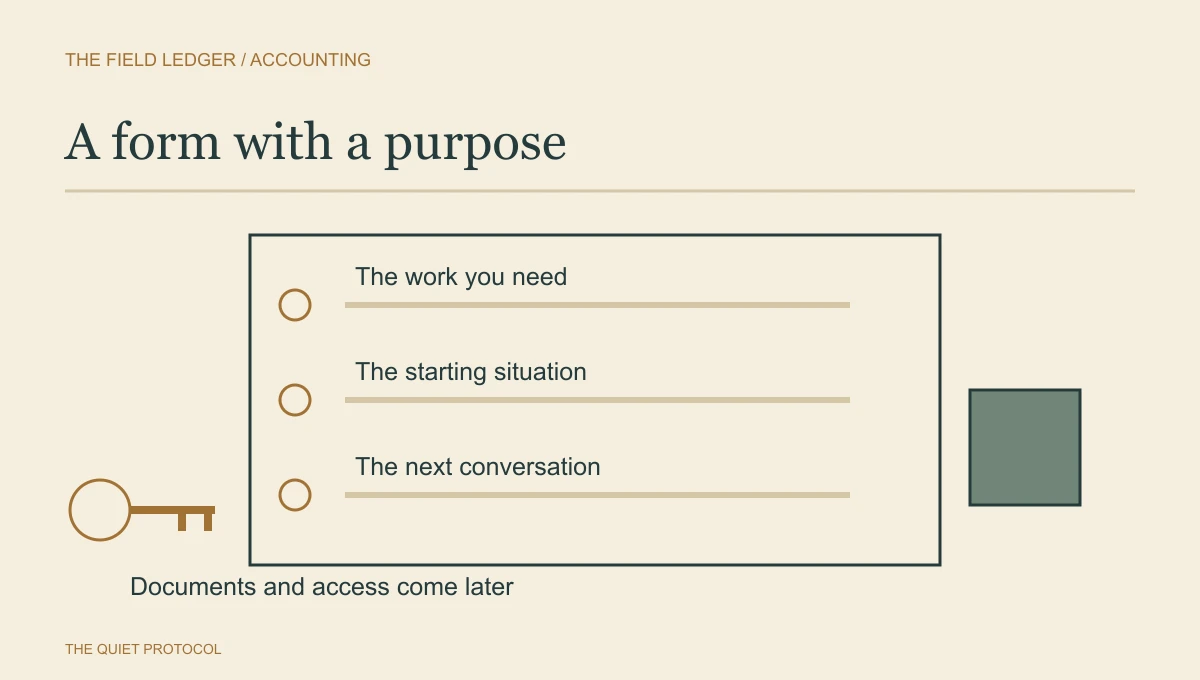
A fit form should not become a file cabinet
A first inquiry rarely needs a tax identifier, full bank account details, a prior return or an upload of every statement. Even apparently ordinary free-text answers can contain private information, so tell people what to leave out and control who sees submissions.
The Canadian OPC safeguards guidance recommends protection appropriate to the sensitivity of information. Your firm's applicable security and professional requirements should govern collection and storage, including the form itself.
If a reviewer needs records before proposing work, send a specific request through the approved channel. Explain what the review is for and how it relates to the next step. An open attachment field does not make a public form an appropriate financial-document exchange.
The later bookkeeping onboarding checklist covers access, source records and responsibilities after acceptance. Keeping that stage separate makes the initial request easier to finish and less likely to imply the firm has taken on the work.
Decide what the submission actually does
For a straightforward, good-fit request, your rule may offer a coordinator call. A possible cleanup project may need a different reviewer before booking. A request outside your services may need a prompt explanation instead of an empty calendar.
Do not let a software branch decide professional acceptance. Let it prepare the route the firm has approved. Someone still needs to assess uncertain cases and make sure the promised response happens.
Send the meeting owner a concise summary of the answers and any unanswered question. The discovery-call guide takes over there. The call should explore the answers, not make the prospect complete the form again out loud.
A useful completion message might say:
Your inquiry has reached [team]. We will review the work and timing you described, then [actual next step] by [firm-approved response time]. You do not need to send financial files with this inquiry. If you need to correct an answer, contact [monitored route].
An immediate receipt is not a promise of an immediate professional decision. Make the distinction understandable.
TQP builds these choices around your services and the people who review them. A monthly-bookkeeping request can prepare a different conversation from uncertain historical work. Branded calendars give each service, person or team its own booking context. The coordinator can see the inquiry and continue the follow-up instead of copying the same answers between a form and a calendar. That is why I would buy a connected client system rather than another form on its own.
Remove a question and see what breaks
Test your form with three illustrative requests: monthly work with current books, uncertain historical work, and a service you do not offer. Try it on a phone. Include “not sure” answers and a correction after submission.
For each field, ask the person reviewing inquiries what they would do differently if the answer changed. If nobody can explain, move the question later or remove it. Then check whether the saved answers actually reach the meeting owner.
Bring your current questions and two ordinary requests to TQP’s accounting client system. We can trim what does not help, shape the website and intake route, and connect the record, booking and follow-up. My recommendation is to buy the whole useful handoff. The prospect gets an easier way to ask for help; your colleague gets a conversation that starts with context rather than another round of the same questions.
Frequently asked questions
What questions belong in a bookkeeping inquiry form?
Ask about the business, the work needed, the relevant period, existing records and the preferred contact route. Distinguish recurring monthly work from historical cleanup because they lead to different scope decisions.
Should the first bookkeeping form collect financial documents?
Keep the first form focused on fit and the next conversation. Request sensitive records later through the firm's approved route, when the team knows what it needs and who will review it.
What turns a bookkeeping form into an intake system?
A system routes the submission to a named reviewer, carries the relevant brief and gives the client a clear next step. TQP designs that receiving path alongside the form, so the inquiry does not disappear into a shared inbox.
Your next busy season.
Better connected.
Your website, intake, booking and reminders, designed and configured together for your firm.
Subscribe by . Setup waived. Your chosen monthly plan rate stays locked into the new year.
Professional website
Up to 10 core pages plus 5 supporting pages, including privacy, terms and other utility pages.
Premium website upgrade
20 to 30 pages with bespoke high-end design and on-site SEO, AEO and GEO optimization.
Solo Premium + AI tools: US$399/month total.
Client-system bonuses: documents, proposals, unlimited e-signing, invoices and payment links.
Free 30 minutes. Bring your website, team size and current software. AI tools help with content and review replies. AI answering, conversational AI, tax preparation and custom integrations are separate. Usage charges remain payable.
Have TQP connect the short form, client record and right calendar in your Client Intake & Booking System, with a professional website included.
Turn your intake questions into a prepared conversation