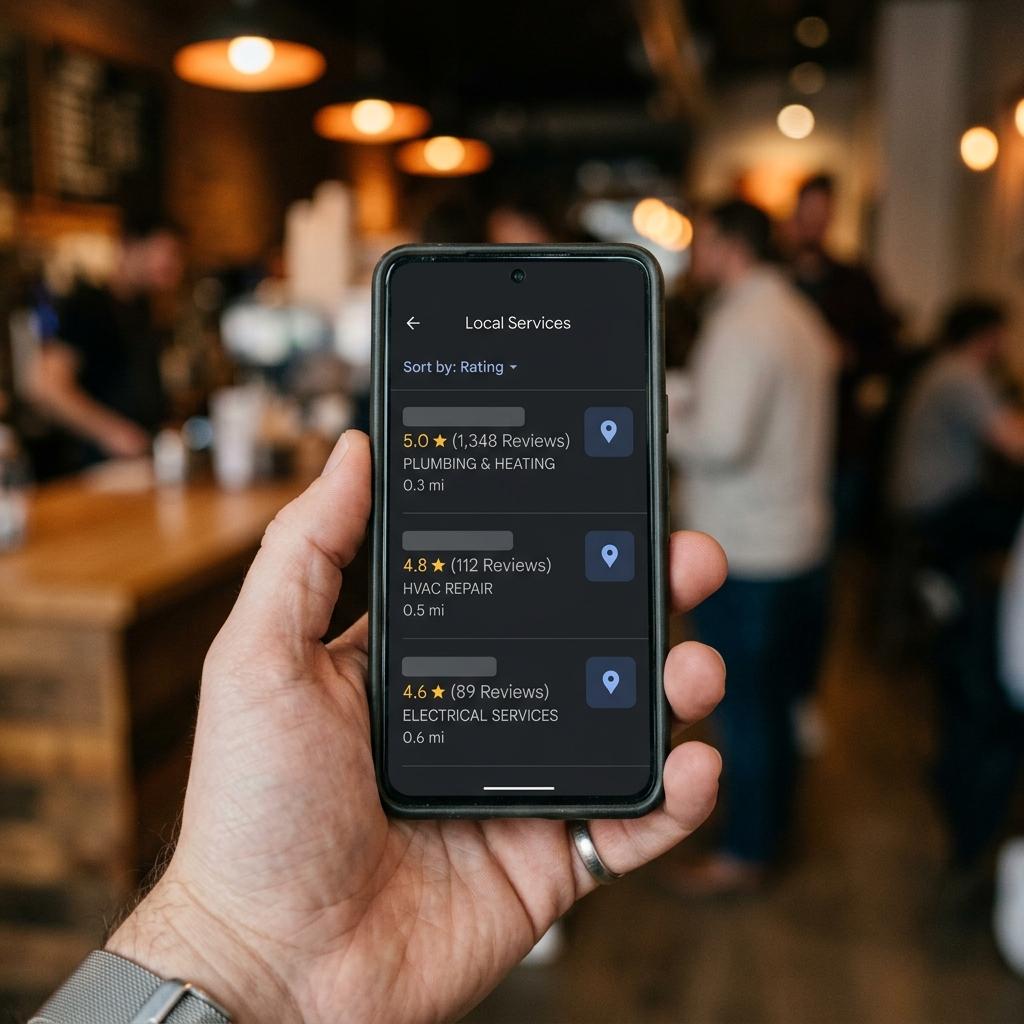

I've had this conversation probably three hundred times in Front Door Audits. And almost every owner is surprised when I point out that star rating is only one of three distinct ways that reviews affect their revenue , and for most businesses operating above 4.0 stars, it's the least important of the three.
This article links to 2 external sources beside the claims they support.
Most service business owners think about Google reviews in terms of star rating. Four stars is good. Five stars is better. A 3.2 is a problem.
I've had this conversation probably three hundred times in Front Door Audits. And almost every owner is surprised when I point out that star rating is only one of three distinct ways that reviews affect their revenue, and for most businesses operating above 4.0 stars, it's the least important of the three.
The review mechanics that actually drive revenue are review volume and review velocity. Most businesses have no system for either.
The Three Revenue Mechanisms of Google Reviews
Mechanism One: Google Maps Ranking
Google Maps ranking is the primary revenue mechanism for most local service businesses. When a homeowner searches "plumber near me" or "HVAC repair [city]," the businesses in the top 3 results capture 70 to 80 percent of the resulting calls. The businesses in positions 4 through 10 share the remainder.
Reviews directly influence prominence. More reviews signal that more people have engaged with the business. Higher review velocity, the rate at which new reviews arrive, signals that the business is active and currently being used.
I ran an audit for a roofing company in Hamilton, Ontario earlier this year. They were in position 5 for their primary service keyword. The business in position 1 had 94 reviews at 4.9 stars. My client had 28 reviews at 4.7 stars. The star rating difference was negligible. The review volume gap was the entire story. We implemented a systematic post-job review request. Sixty days later, they had 61 reviews and had moved to position 2. Same website, same service area, same Google Ads budget.
Mechanism Two: Click-to-Call Conversion Rate
Once a business appears in Google Maps search results, reviews affect whether the searcher clicks to call.
In practical buyer behavior, review count can matter more than another decimal point of rating once the business is already above an acceptable trust threshold. A business with 85 reviews at 4.3 stars gets more clicks than a business with 14 reviews at 4.8 stars because volume signals that more people have verified the business's quality.
Above the 4.0 star threshold, additional star improvement produces diminishing returns in click behavior. The difference between 4.2 and 4.7 stars is small. The difference between 14 reviews and 85 reviews is significant.
This means for most service businesses operating above 4.0 stars, the goal should be volume and velocity, not chasing perfect scores.
Mechanism Three: Trust and Conversion Rate at First Contact
When a homeowner calls a service business, they've typically already viewed the Google Maps profile. The first impression, before the call is even answered, is the reviews they saw.
A business with 60 reviews and a 4.6 average produces a different first-contact frame than a business with 8 reviews and a 4.9 average. The prospect who saw 60 recent, detailed reviews arrives at the call with a higher baseline of trust. They're more likely to schedule, less likely to ask competitive pricing questions, and more likely to become a completed job without extended objection handling.
This trust pre-loading from review volume is one of the most underappreciated revenue effects in local service marketing.
The Review Velocity Gap and Why It Compounds
Review velocity is the rate of new review generation. It compounds because of how Google's freshness component works.
A business that generated 30 reviews over three years has an average review age of 18 months. A business that generated 30 reviews over six months has an average review age of three months. Recent reviews can give buyers and search systems a fresher signal of current business quality than a profile that has not earned public feedback in a long time.
The velocity gap compounds fast. After 12 months:
Business A (no systematic review generation): 2 to 3 organic reviews added. Velocity near zero. Average review age growing.
Business B (systematic post-job review requests): 40 to 50 new reviews added. Velocity of 4 per month. Average review age resets continuously.
After 24 months, Business A and Business B might have launched with identical review counts. Business B now has 80 to 100 more reviews, a lower average review age, and a meaningfully stronger ranking signal.
This is why the businesses I work with that are six months into a systematic review process become structurally difficult to overtake. A competitor that starts a review program today is competing against 24 months of compounding velocity. The math doesn't favor catching up quickly.
The Revenue Math of a Google Maps Ranking Improvement
Understanding the revenue impact of moving from position 5 to position 2 in Google Maps for a primary category requires knowing the call volume differential.
Local search click-through rate data shows that the top result in a Google Maps pack receives approximately 33 percent of clicks. The second result gets about 18 percent. The third gets about 12 percent. Position 4 and below share the remaining 37 percent, each progressively receiving less.
For a business currently in position 5 receiving an estimated 6 calls per month from Maps search, a move to position 2 would increase that to approximately 18 calls per month.
At a 30 percent close rate and a $700 average ticket:
- Position 5: 6 calls × 30% × $700 = $1,260 per month from Maps
- Position 2: 18 calls × 30% × $700 = $3,780 per month from Maps
- Annual difference: $30,240
This improvement is achievable through review velocity improvement alone, without changing the website, the advertising, or the service.
The roofing company in Hamilton from earlier? Their monthly inbound calls from Maps went from 11 to 28 in 90 days after the ranking moved. At their average ticket, that translated to roughly $18,000 in additional monthly revenue potential. Not all of that closes, but the math holds at realistic close rates.
How Service Businesses Build Review Velocity Systematically
The businesses generating 4 to 8 reviews per month don't rely on asking customers verbally or hoping for organic reviews. They have a structured process with specific timing, a specific channel, and a specific message.
The high-conversion review request formula:
Send a review request via SMS within two hours of job completion. The request is personal, not a mass email: "Hi [Name], this is [Tech Name] from [Company]. Really glad we could get your [system/issue] sorted today. If you have a minute, a Google review would mean a lot to us: [direct link]."
Two-hour timing matters. Satisfaction is highest immediately after a successful job. The longer the gap between completion and request, the lower the response rate. The sweet spot is that two-hour window when the homeowner is relieved and the experience is vivid.
A direct link to the review form, not to the Google Business Profile page, is essential. Every additional navigation step reduces completion rate by a meaningful fraction. The businesses getting 1 in 3 customers to leave reviews are using a direct link that opens straight to the review box. The businesses getting 1 in 10 are sending people to their profile and hoping they find it.
SMS outperforms email for review requests by the same margin it outperforms email for almost everything in local service: higher open rates, faster reads, and a more direct path to action on mobile devices where most reviews are written.
How to Respond to Negative Reviews Without Making Things Worse
Negative reviews produce disproportionate anxiety for service business owners. I've watched owners draft responses late at night that they're clearly writing from a place of frustration. Those responses never help.
The most common mistake is the defensive response, rebutting the reviewer's claims, explaining why they're wrong, or providing operational context that reads as excuses. Defensive responses signal to every prospective customer reading the review that the business disputes customer concerns rather than resolving them.
The effective formula is: acknowledge, express concern for the experience, offer resolution.
"We're sorry to hear about your experience. This isn't the level of service we aim for, and we'd genuinely like to make it right. Please reach out to us directly at [number] so we can address this properly."
This response doesn't validate a false claim. It doesn't confirm a negative narrative. It demonstrates to every other prospective customer reading it that the business takes complaints seriously and responds professionally. That demonstration often matters more to future conversion than the negative review itself.
I tell business owners: your response to a 1-star review is marketing to everyone who reads it after the reviewer.
Use Your Own Review Data Before You Decide
Use this section as a quick buyer check. A service business owner does not need another vague automation pitch. They need to know which part of the front door is leaking, what the system will change, and how they will measure whether the fix is working.
Source method: compare the article against your own call log, CRM notes, booking calendar, missed-call records, web form timestamps, and Google Business Profile review recency. Those records are more useful than a generic benchmark because they show what buyers actually experienced in your business.
What proof should I look for in my own business?
Look for proof in the places where demand either moved forward or stalled: missed calls, short calls, unbooked forms, slow callbacks, no-show recovery, old leads, and reviews that were never requested. If the business cannot see those moments clearly, the first improvement is better tracking and routing.
How do I know whether this is a marketing problem or an operations problem?
If people are already calling, filling forms, asking for prices, requesting appointments, or comparing reviews, the problem is usually operations. More marketing will not fix a front door that lets warm demand wait. The better move is to capture and route the demand already arriving.
What should happen after the first response?
The first response should create a next step: booked appointment, estimate path, intake handoff, callback window, review request, or reactivation sequence. A response that only says someone will get back to you is not enough when the buyer is comparing several providers at once.
Where does The Quiet Protocol fit?
The Quiet Protocol fits when the business already has demand but too much of it depends on manual attention. We connect AI receptionist coverage, web intake, missed-call recovery, booking logic, follow-up, review requests, and reactivation into one managed front-door system.
The loss estimate is basic business math, not a magic claim.
Revenue-leak examples on this site are built from visible operating inputs: inquiry volume, missed-call or slow-response rate, booking rate, average job or client value, repeat value, and follow-up recovery. The fastest way to make the number real is to run the diagnostic for your closest business type, then compare it against your own call log, CRM, booking calendar, form timestamps, and review activity.
The practical questions behind this decision.
What proof should I look for in my own business?
Look for proof in the places where demand either moved forward or stalled: missed calls, short calls, unbooked forms, slow callbacks, no-show recovery, old leads, and reviews that were never requested. If the business cannot see those moments clearly, the first improvement is better tracking and routing.
How do I know whether this is a marketing problem or an operations problem?
If people are already calling, filling forms, asking for prices, requesting appointments, or comparing reviews, the problem is usually operations. More marketing will not fix a front door that lets warm demand wait. The better move is to capture and route the demand already arriving.
What should happen after the first response?
The first response should create a next step: booked appointment, estimate path, intake handoff, callback window, review request, or reactivation sequence. A response that only says someone will get back to you is not enough when the buyer is comparing several providers at once.
Where does The Quiet Protocol fit?
The Quiet Protocol fits when the business already has demand but too much of it depends on manual attention. We connect AI receptionist coverage, web intake, missed-call recovery, booking logic, follow-up, review requests, and reactivation into one managed front-door system.
Review the trust signals visible before someone decides to call.
The useful question is not only the star rating. It is whether recent proof supports the promise the website makes.
Inspect review recency, response habits, and the public trust signals buyers see before they contact the business.
See how the capability in this article fits into a complete customer journey.
Service BusinessesSee the same decision through the language, buyer behavior, and operating reality of this industry.
Client Results & ProofInspect the starting condition, installation, measurement window, and outcome behind real client work.

The 5 Silent Signals Your Service Business Is Leaking Revenue Right Now
Five diagnostic signals that reveal how much revenue a service business is silently losing through operational gaps. Most service businesses losing six figures annually across these five channels have no idea the leak exists.

What Is a Revenue Leak Diagnostic? The Single Dollar Figure That Shows What Your Service Business Is Actually Losing
The Revenue Leak Diagnostic is the total annual revenue a service business is leaking through operational gaps. Here is how it is calculated, what inputs it uses, and what the number typically looks like.

Dormant Customer Reactivation: Build a Safe First Cohort
Choose one verified customer group, offer one relevant next step, prepare the response path, and learn from completed outcomes before expanding outreach.