To start a cleaning business, decide first whether you clean homes or buildings, because they are two different businesses with different customers, hours and phone calls. Then handle the two things new owners get wrong: how you pay the people who clean, and the chemicals they use. Then build a way to capture every quote request, since in cleaning most first calls are a request for a price.
We sell an AI voice agent, so we care about that third part. The rules for workers and chemicals come from government pages, and we link them so you can read them yourself.
Residential or commercial: two different businesses
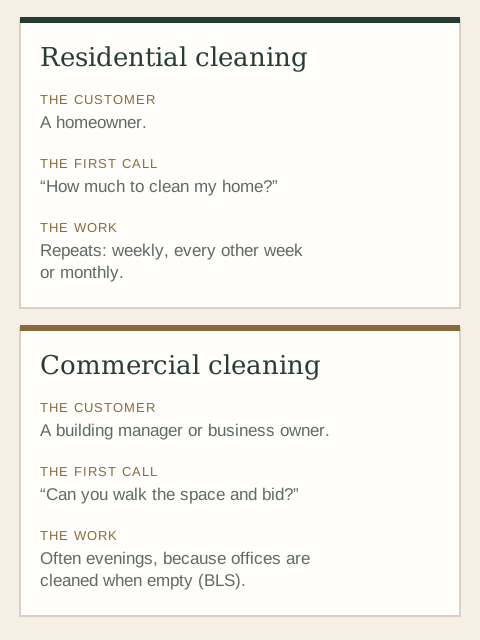
Residential. The customer is a homeowner who wants a price for their home, and the work repeats. The call is a quote request, and the customer is likely asking more than one company.
Commercial. The customer is a building manager or business owner who wants a walkthrough and a bid. The Bureau of Labor Statistics says many cleaners work evening hours because office buildings are often cleaned when empty, so your crew's hours and your calls fall at different times of day. A commercial contract can be worth more per customer, and it may come with insurance and contract requirements.
You do not need a license to clean, according to BLS. Your state or city may still require a business license, and registration, tax IDs and insurance apply either way. The U.S. Small Business Administration lists the order most new businesses follow: choose a structure and name, register, get tax IDs, apply for licenses and permits, open a bank account and get insurance. Ask an accountant and an insurance agent about yours.
The two rules new cleaning owners trip over
Paying your cleaners: employee or contractor
It is tempting to treat every cleaner as a contractor. The IRS says the label is not what counts. It looks at three kinds of evidence:
- Behavioral control. Do you control, or have the right to control, what the worker does and how?
- Financial control. Who sets the pay, reimburses expenses and supplies the tools and materials?
- The relationship. Is there a written contract or employee-style benefits, is it ongoing, and is the work a key part of your business?
The IRS says no single factor decides it and that misclassifying an employee as a contractor without a reasonable basis may mean owing employment taxes. If you cannot tell which side a worker falls on, ask an accountant before you hire. This is not tax advice.
Chemicals
OSHA's Hazard Communication Standard applies to employers with hazardous chemicals in the workplace. It says employers must have labels and safety data sheets available to exposed workers and train workers to understand the hazard information and handle the chemicals appropriately. Cleaning products are chemicals. Before your first employee uses one, find the safety data sheets, keep them where the crew can reach them and ask a safety professional what training you need.
BLS also notes that cleaners commonly get sprains and strains from lifting and repetitive motion, so safe lifting is part of the training too.
Every first call is a quote request
Your phone will not ring with "book me." It will ring with "how much to clean my place?" The answer depends on what you ask, and the questions are the same every time. Write them once.
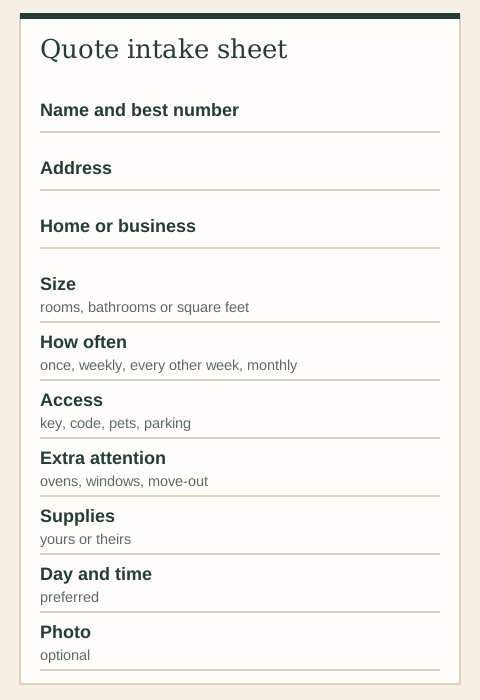
A cleaning company that misses a call misses a quote request, and the customer asks the next company. That is why the sheet matters. Whoever answers, you, a person or an AI voice agent, fills in the same ten fields.
A quote reply you can send in a minute
Hi Priya, this is Sam from Brightside Cleaning. Thanks for calling about your three bedroom. To give you a firm price, can you tell me the number of bathrooms, how often you would like us, and whether there are pets? I can also come by Thursday afternoon for a quick walkthrough if you prefer.
It asks the questions that set the price and offers a next step. Brightside is a made-up example. Use your own name, and send it the moment you miss a call.
Your business plan on one page
You do not need a thick document. Answer five questions and keep the page:
- Who do you clean for first, homes or buildings, and in which towns?
- What is in a standard visit, and what costs extra?
- How many jobs can you and your crew handle a week? That is your capacity.
- How will customers find you and reach you?
- Who answers when you are mid-clean?
The fourth and fifth answers are the ones owners skip. Local Ranking Accelerator handles the fourth: a managed business identity and consistent listings, so nearby customers find you. Price: $99/month, or $82.50/month billed yearly. Google also lists house cleaning, carpet and upholstery cleaning and window cleaning as Local Services Ads categories, with verification that takes on average three to four weeks, so ask early.
Where the voice agent fits
Our Essential AI voice agent plan answers 24/7 in English, Spanish or French, asks your intake questions, books the walkthrough or the first visit, texts you the summary and texts back callers you miss. Price: $449/month with 600 minutes of calls, free setup, no contract. The plan also includes a customer system with a job pipeline, a booking calendar, a website of up to ten pages and a phone app that sends estimates, takes payment and sends review requests.
It does not clean, and it does not replace your first walkthrough. If you are one person with a handful of clients, you may not need it yet. Start with the paperwork, the intake sheet and a phone rule, and add the agent when missed quote requests cost you more than the plan costs. We do not promise any number of jobs.
Do this before your first customer
- Choose residential or commercial to lead with, and write it down.
- Register the business and get insurance, and check your state and city for a business license.
- Decide how you will pay cleaners, and ask an accountant if you are unsure.
- Collect safety data sheets for every product you use.
- Write the ten-question intake sheet and test your phone with it.
To hear ours take a quote request, call the demo line at +1 855-916-4334, see the home services page or book a demo built around your company.
Frequently asked questions
Do you need a license to start a cleaning business?
The Bureau of Labor Statistics says no license is required for the janitor and building cleaner occupation. Your state or city may still require a business license, and you need to register the business, get tax IDs and insurance. Check with your state and city.
Are cleaners employees or independent contractors?
The IRS decides by how much control you have over how the work is done and how it is paid, and by the nature of the relationship, not by what you call it. Misclassification may mean owing employment taxes. Ask an accountant before you hire.
What do you need to quote a cleaning job?
The address, whether it is a home or business, the size, how often you will clean, access details such as codes or pets, any areas that need extra attention, who supplies the products, and the day and time they prefer. For larger or commercial jobs, add a walkthrough.
Facts about workers and chemicals come from the Bureau of Labor Statistics (page last modified August 27, 2026), the IRS, OSHA and the U.S. Small Business Administration, read October 11, 2026. Requirements differ by state and change. This is not legal, tax, insurance or safety advice. Confirm your own requirements with your state, city and a qualified advisor.
See how TQP builds a cleaning website and sets up call handling to collect job details, arrange a walkthrough and send your team the record.
See the home services page