
Personal injury intake is a race you rarely see. The caller reaches out after a collision, nobody records when, and by the time a lawyer looks, the request has aged. Your intake process should log the arrival, gather your firm's approved minimum facts and put the next review with a responsible attorney or supervised intake owner. Legal judgment and acceptance stay with your firm.
Imagine a fictional caller trying to explain a collision after the office has closed. They may have notes, questions and uncertainty about what matters. A long questionnaire asks them to perform the entire intake before anyone has explained who will help. A silent voicemail gives them no reason to know whether the firm received anything.
Make the first step clear and the second step real. The caller should understand who is speaking, what information is being requested and what the firm has actually promised. Receipt of a request is not acceptance of a case.
Choose The Quiet Protocol's AI Receptionist for the approved administrative beginning. From US$449 per month with free setup (normally US$1,495), we configure and test the questions, receiving records and human handoffs, then maintain the installed paths. There is no contract, and call minutes are included in the plan. Your firm defines and supervises the professional process. We make it easier for the caller to reach that process without leaving the team an unowned transcript.
Record the beginning accurately
Use the actual received date, time and channel, with the time zone where needed. Keep the caller-reported event timing separate. A call received tonight and an event the caller says happened earlier are different facts. Neither should be turned by intake software into a legal deadline.
Ask for a safe return contact and whether leaving a voicemail is appropriate. Record the broad matter in the caller's words, location and any timing question the firm has approved for its first screen. The lawyer sets the exact information needed for its fit and conflict review.
Do not require the caller to retell every private detail before a person can review the request. ABA Model Rule 1.18 addresses prospective-client information; its comment recommends limiting an initial consultation to information reasonably necessary for the decision. These are US model provisions, not a universal rule for every jurisdiction. Your firm's governing obligations determine the actual screen. ABA Model Rule 1.18, comment 4
Preserve missing facts as missing. If a call drops before a safe contact route is confirmed, mark the record incomplete and send it through the firm's approved review path. A full-looking transcript without a usable callback is not complete intake.
The request moves through separate decisions
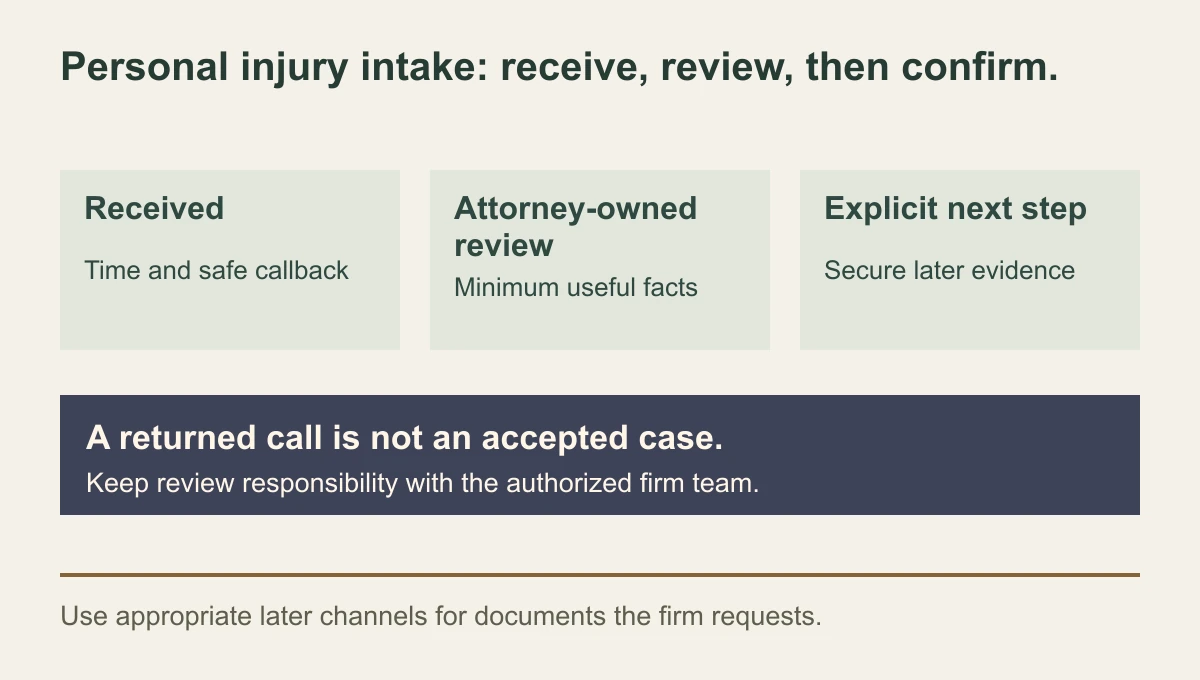
- Received: actual contact timestamp, channel and the caller's words are recorded. No eligibility or case-value conclusion.
- Minimum screen: approved contact, matter and routing facts, with missing information visible and sensitive detail limited.
- Review owned: named attorney or supervised intake owner, acknowledgment, genuine contact promise and backup for absence.
- Further information requested: the firm's authorized team decides what is needed and supplies its approved secure route.
- Next step communicated: review pending, further conversation arranged or another firm-approved response. Representation is a separate professional decision.
Let an attorney own the judgment
The assistant should not score liability, assess an injury, predict compensation or tell someone what legal action to take. A question such as “Will you take my case?” needs the firm's professional process. The receptionist can record it and arrange the next conversation.
ABA Formal Opinion 506 discusses nonlawyer intake under lawyer supervision and access to a lawyer to discuss scope and fees. That supports defining supervised roles, rather than treating delegation as a transfer of the lawyer's professional responsibility. It does not approve autonomous AI representation decisions. ABA Formal Opinion 506
The intake owner needs enough context to continue without forcing the caller to begin again: confirmed safe contact, broad request, reported timing, unanswered question and exact promise. Keep acknowledgment and actual contact separate in the log. Someone accepting a task does not mean the caller has spoken with an attorney.
If no authorized person is available now, state the genuine next review point. Do not invent “a lawyer will call tonight” because a caller sounds worried. Any request outside the approved first-contact scope follows the firm's defined exception route rather than receiving improvised advice.
Request later evidence through the firm's approved channel
Photos, medical records, insurance correspondence or other documents may become relevant. The attorney or authorized team decides what to request and when. First-contact automation should not ask the caller to attach an entire sensitive file to an ordinary email or text just to advance a pipeline stage.
Provide the firm's approved secure route and clear instructions for the requested material. Record who asked, what was requested and where the receiving team will review it. Do not promise that uploading evidence makes the person a client or proves the firm can act.
Set access and retention through the firm's approved process. An AI summary should not invent a fact absent from the record, and a receiving lawyer should be able to distinguish the caller's account from a prepared summary. These are implementation questions to settle with the firm, not a blanket privacy or compliance guarantee.
Test the promise when the usual owner is away
Arrange labelled fictional requests for an ordinary inquiry, incomplete contact information, a possible conflict, a caller declining detailed questions and a request for advice outside the script. Use the firm's approved test path so nobody treats the request as a real matter.
Make the usual receiving person unavailable. Check that the backup receives the record and the caller hears the actual contact plan. Test a dropped call and a later correction to the return number. The working record should contain the corrected fact, not merely a transcript that mentions it somewhere.
We define these normal and exception checks for the agreed TQP implementation, configure the route and monitor the installed handoffs. Your firm approves the questions and supplies the people who review and advise. The continuing work should reduce the burden of reconstructing calls, not add a new daily inbox of uncertainty.
At the next staff review, identify requests still waiting for the contact the firm promised. Name the next owner and action. Keep received inquiries, attorney conversations and representation decisions separate. Attaching an imagined case value to every unanswered ring cannot explain which handoff failed.
Bring one approved first-contact screen and one anonymized receiving record to our law firm marketing team. Let us build a beginning the caller can understand and your attorneys can supervise. That is a better reason to improve intake than making a machine sound confident about a case it cannot decide.
Frequently asked questions
What should a personal injury firm's first intake record contain?
Capture the caller's stated beginning, a usable and appropriate contact route and the limited context the firm needs to decide who reviews next. Keep the record accurate without presenting intake as a merits assessment.
Can AI decide whether an injury claim is valid?
The firm's attorney owns professional judgment. A configured intake route can receive approved information and direct the caller to review, but should not invent case assessments or acceptance promises.
How does TQP help an injury firm carry the next inquiry?
We connect the first-contact route to a usable receiving brief and a named reviewer. Test the absent-owner situation as well as the ordinary call so an unanswered internal handoff does not leave the caller with a false promise.
We configure approved first questions, clear receipt and callback states, receiving records and human handoffs, then test and maintain the installed receptionist. Your attorneys own review and representation decisions; callers receive an accurate next step.
Build a respectful, attorney-owned intake handoff