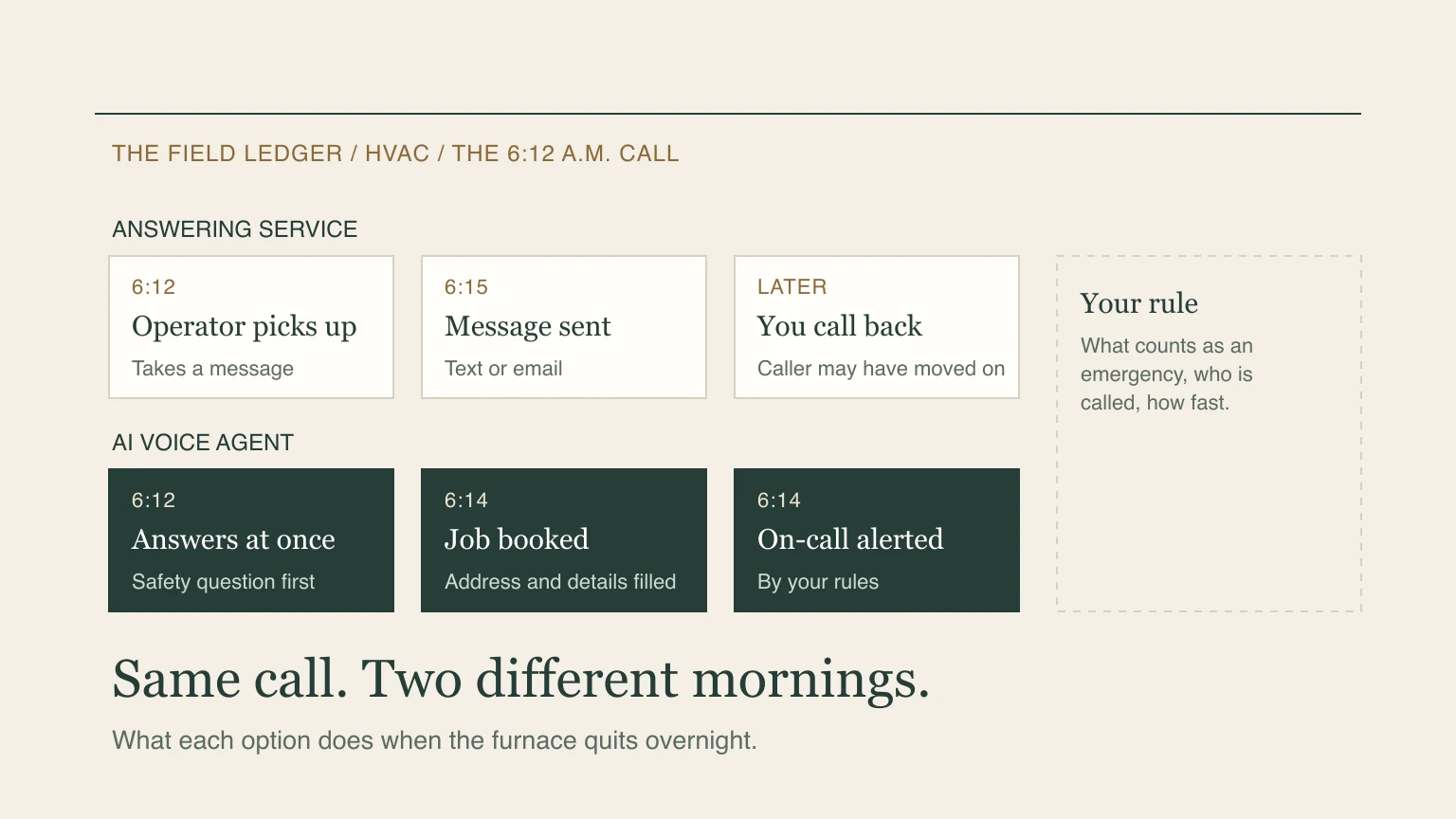
Picture 6:12 on a January morning. The furnace quit overnight, the house is cold, and a homeowner is calling every HVAC company in town. The first one to pick up and sound like they can help gets the job. The rest get a voicemail greeting.
If you run an HVAC company, you have three ways to handle that call. You can let it ring through to voicemail. You can pay a human answering service to pick up. Or you can put an AI voice agent on the line. This guide compares the second and third on what matters: what they cost, what the caller experiences, what you get afterward, and where each one falls short. Published prices and provider features were rechecked October 27, 2026. The call scenarios below are illustrations, not a measured test of either service.
What an HVAC answering service does
A traditional answering service puts a trained person on the phone. They greet the caller in your company's name, take a message and pass it to you by text, email or phone. Some will follow your instructions for emergencies, like calling your on-call technician. Some will book appointments if you give them access to your calendar.
The strength is a human voice and human judgment. A good operator can calm a frightened caller, handle an odd question and know when to escalate. The limits are cost and consistency. Human services bill by the minute or by the call, and the person who answers may be handling several businesses at once.
Published pricing from two well-known services:
| Service | Plan | Price | What it includes |
|---|---|---|---|
| Ruby | 50-minute plan | $250 a month | 50 minutes |
| Ruby | 200-minute plan | $720 a month | 200 minutes |
| Smith.ai | Starter | $300 a month | 30 calls, then $11.50 per extra call |
| Smith.ai | Basic | $810 a month | 90 calls, then $10.50 per extra call |
Compare the work included as well as the allowance. Ruby lists scheduling among its features. Smith.ai lists appointment booking as an additional $1.50 per call. Confirm contract terms, calendar access, extra charges and your approved call instructions before choosing.
What an AI voice agent does
An AI voice agent answers by itself, at any hour, in a natural voice. It asks the questions you approve, records the service request and sends the agreed notification. Creating a dispatch job depends on the system and connection you have bought. For HVAC, that means it can ask the same seven questions on every no-heat call: whether there is a gas smell or a carbon monoxide alarm, who in the home is vulnerable, what the system is, the address, how urgent it is, who the caller is and whether there is anything else the technician should know.
It does not diagnose or decide whether a property is safe, and it should not invent a repair quote. It can book within the calendar and rules you have configured, or collect a request for staff to confirm. Your approved emergency instructions and human fallback need to work when an on-call person cannot answer.
The Quiet Protocol builds and configures your AI answering service around your approved HVAC call rules. Plans are from $449/month, free setup, no contract. Both include a CRM, booking calendar, starter website and mobile app. Your phone gets the call summary; your admin address gets the summary and transcript. Call recording is included. The agent can answer approved FAQs, send your booking link or book on the included calendar.
When you compare AI plans, compare setup as well as minutes. Rosie lists $149 a month for 1,000 minutes with booking and warm transfers, and assisted onboarding on its $299 Growth plan. With TQP, the purchase includes the work of configuring your answering service. Ask us to show your call rules, the record your office receives and the next step when booking or handoff cannot finish.
The same call, two ways
Here is what to compare on the 6:12 a.m. call. These are possible configurations; ask each provider to demonstrate the one you would actually buy.
| Human answering service | AI voice agent | |
|---|---|---|
| Who answers | A trained operator | An AI voice agent, in a natural voice |
| First question | Your approved script, with human judgment for exceptions | Your approved script, with defined escalation for exceptions |
| Emergency routing | Operator calls your on-call phone, if the script says so | Texts and alerts your on-call phone by your rules |
| Booking | Confirm the supported calendar and booking instructions | Confirm whether it sends a link, books a slot or collects a request |
| After the call | Check the message, transcript and software record included in the plan | Check the summary, transcript, recording and actual booking status |
| Busy morning, five calls at once | Check staffing, queue limits and overflow | Check simultaneous-call capacity, failed calls and fallback |
| Unusual or emotional call | A person can improvise | It follows your rules and hands off to a person when you say so |
| Cost shape | Per minute or per call, or a fixed tier | One flat monthly plan with minutes included |
Neither wins every row. A person can use judgment on an unusual call. An AI can repeat approved instructions, but capacity and handoff still need testing. You can combine automated answering with human escalation when that fits your calls.
Who sets up your HVAC answering service?
A pleasant voice is only the first check. Someone still has to decide which calls you take, where you work and what your office receives. With TQP, we do the configuration. You supply the business decisions and approve the result.
- You set the rules. Give us your service area, hours, equipment and jobs you accept, approved fee wording, booking rules and on-call contacts. Separate a service visit from a replacement estimate or an existing customer's callback.
- We build the answering path. We configure the greeting, approved answers, intake questions, included calendar or booking-link path, and the summary and transcript delivery. A connection to your separate dispatch software has its own agreed scope.
- We review the result with you. Use your actual call types to check the questions, corrected details, booking status and human fallback before forwarding customer calls. Your office still owns dispatch, technical decisions and commitments to the customer.
Your team should not have to listen to every recording to discover whether the caller is waiting. Agree who acts on an unbooked request and what the caller is told while they wait. The transcript supports that work; it does not replace it.
Can you keep your existing dispatch software?
Start with what the answering service must do in it. Taking a message, creating a lead, requesting an appointment and confirming a slot are four different jobs. Ask to see the result in the software your office actually uses.
For TQP, the standard voice plans include a booking calendar. A connection to your existing field-service software is separate work: we confirm access, the records to create and the failure path before agreeing the scope. Keeping your current system does not mean every connection is already available.
Before launch, test a new caller, an existing customer, an unavailable appointment and an unsuccessful handoff. Check that the address and service request arrive once, the right person owns the next step, and the caller is told accurately whether the visit is booked or waiting for confirmation. If booking fails, the team needs a visible request to act on. Use the lead handoff checklist to write down those responsibilities.
A cost check you can run yourself
The honest way to compare is with your own numbers, not ours. Pull your phone records for last month. Count calls, and note how long they ran. Then compare:
- Calls and minutes. How many calls last month, and how long did they average?
- Missed calls. How many went unanswered, and how many of those were after hours?
- What a booked job is worth. Your average service-call ticket, and how often a no-heat call turns into a replacement.
- The plan that fits. Match your minutes or calls to each plan above. Do not buy more than you use.
A simple, illustrative example, with assumptions stated so you can swap in your own: if a shop gets 120 calls a month averaging 2.5 minutes, that is 300 minutes. If 20 missed calls were separate, suitable enquiries and half would have become completed $450 jobs, that is $4,500 in possible revenue before costs. Deduct enquiries that called again, booked another way or were recovered by your team. This does not show what a competitor earned or what you will recover. The numbers are an illustration, not a forecast. Your phone records will tell you the real figure, and the Revenue Leak Diagnostic will do the arithmetic with your inputs.
Test any option in 15 minutes
Before you pay for anything, call it. Whether it is an answering service's demo line or ours, run these five tests:
- Say there is no heat and it is freezing. Does it ask about gas or carbon monoxide first?
- Interrupt it mid-sentence. Does it stop and listen, or talk over you?
- Ask what a repair costs. It should not invent a price. It should use your approved wording and offer only the booking or callback path you have agreed.
- Change the address halfway through. Does the receiving record reflect the correction?
- Ask for a person. Does it hand off cleanly, or loop?
Hear the voice on our live line at +1 855-916-4334. For your HVAC rules, receiving record and booking path, book a demo built around your company. The public line is not your configured installation. Bring one routine service call, one replacement enquiry and one failed-handoff scenario. Ask to inspect the resulting records, then run the same checks on any other option.
Where each one falls short
Answering services can become expensive at volume. If the plan only takes messages, someone still has to call the customer back. A service that books or updates your software may reduce that extra step, so compare the actual scope.
AI voice agents do not diagnose, they cannot read a room the way a person can, and they only know what you teach them. They also answer calls from a phone number, so how well they perform depends on how clearly you set the rules. Outbound calling by an AI voice has consent rules in the United States and Canada, which is why we do not include it in standard plans.
Voicemail is the cheapest and the one that costs the most.
What to do this week
- Review one week of after-hours phone records. Separate genuine new enquiries from repeat calls, spam and existing jobs.
- Write down your emergency rule in one paragraph: what counts, who is called and how fast.
- Run the five test calls on a demonstration number and inspect the receiving records before changing your live call routing.
- Decide on what happens after the call, not only on the voice.
If you want the fastest start, see the two plans, or read how we think about HVAC marketing end to end. If you are already running Google ads or Local Services Ads, read why paid calls are only worth what you answer.
Frequently asked questions
Is an AI voice agent better than an answering service for HVAC?
It depends on your calls and the configured service. Either can capture details and book with the right access. Compare handling of unusual calls, simultaneous-call limits, confirmed calendar entries and the human fallback. Use the same test on both before choosing.
Can an AI voice agent handle a no-heat emergency?
It can ask the approved questions, such as gas smell or carbon monoxide alarm, record the details and alert your on-call phone by your rules. It does not diagnose or quote a repair, and it should hand off when you tell it to.
How much does an HVAC answering service cost?
Published prices run from about $250 a month for 50 minutes to about $810 for 90 calls, depending on the service and how it counts. Check each pricing page, because plans change.
Prices and plan details for third-party services are taken from each company's published pricing page on October 27, 2026 and change often. Check the current page before you decide.
Compare the managed Essential and Growth plans, inspect the after-call record and bring your HVAC call rules to a personalized demo.
See the two AI voice agent plans