Try something. Search for how many small businesses use AI, and write down every number you find.
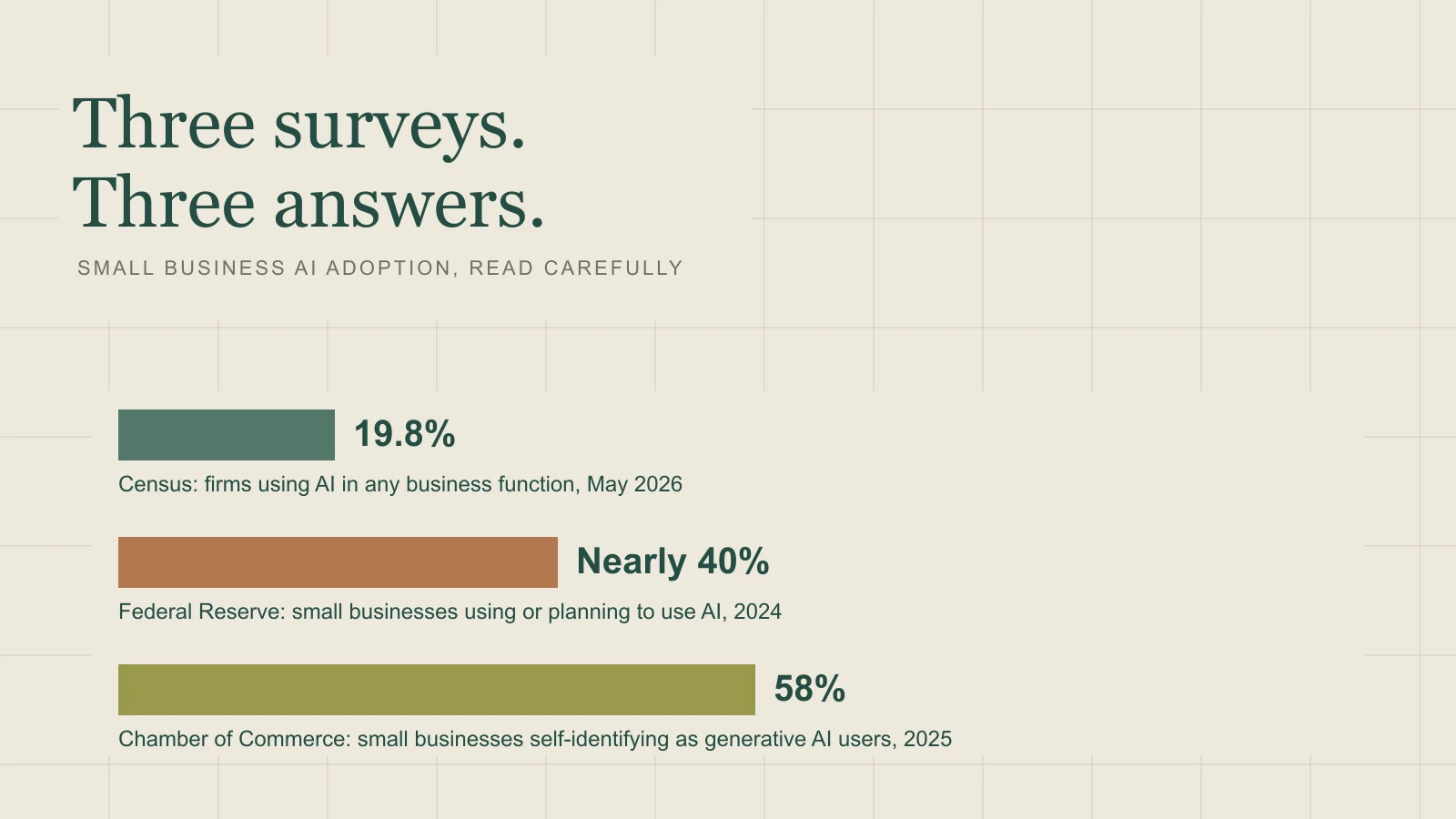
I did. The Census Bureau says about 20%. The Federal Reserve Banks say nearly 40%. The U.S. Chamber of Commerce says 58%.
Same country. Same question, more or less. Almost three times apart.
So who got it wrong? Nobody. They counted different things. And that is the interesting part.
What each one counted
The Census Bureau asks the simplest question. Did your business use AI in the past two weeks?
As of May 3, 2026, 19.8% said yes. From December to May it stayed between 17% and 20%. That is firms of every size, from the corner crew to the big corporation.
There is a catch. In November 2025 the bureau changed its wording. Before, it asked about AI "in producing goods or services." Now it asks about use "in any business function."
So if you see a neat line chart running straight through that month, do not trust it.
The Federal Reserve Banks found nearly 40% of small business respondents in 2024. Look closely. Using or planning to use.
Put "look into AI next year" on your to-do list, and congratulations. You are in the 40%.
The same write-up lists why other owners stayed out. They worried about accuracy and intellectual property. They said human contact matters to how they work. Or they felt AI just does not apply to what they do.
I would give that last group some credit. At least they answered honestly.
Then there is the Chamber of Commerce, working with Teneo Research. 58% of small businesses in 2025. Up from 40% in 2024 and 23% in 2023.
Notice the word "self-identified." It means the respondents called themselves generative AI users. The report does not say anyone checked.
Asked a chatbot once to make an email sound less angry? You can say yes with a clear conscience.
The report page I read gives no sample size, no dates for when the survey ran, no weighting and no margin of error. I would not put a decimal point on it.
Three numbers, three yardsticks
- Census: 19.8%
- Any business function, past two weeks. Firms of every size, surveyed from December 14, 2025 to May 3, 2026. Wording widened in November 2025.
- Federal Reserve: nearly 40%
- Using or planning to use AI. Small business respondents to the 2024 Small Business Credit Survey. The page does not define use.
- Chamber of Commerce: 58%
- Self-identified generative AI users. Small businesses surveyed in 2025 with Teneo Research, up from 40% in 2024 and 23% in 2023.
Do not subtract one from another. They are different measurements, not different readings of one dial.
None of them is useless. They just answer three different questions.
Chamber: how many owners have played with a chatbot. Census: how many firms have AI working somewhere. The Fed: how many are at least thinking about it.
"How many businesses use AI" is not on that list.
If you run a small crew, read this twice
Here is the finding I would keep.
Census found use goes up with size. 37% of firms with 250 or more employees. 32% of firms with 100 to 249. Under 20% of firms with four or fewer.
Firms with fewer than 20 employees showed no significant change over the period. The bigger firms moved up.
So if you run three to fifteen people, the headline growth is not coming from businesses like yours. You are not behind a crowd of 58%. You are in the part of the market where nothing is settled yet.
I find that cheerful. It is my reading, not something the survey proves.
It means you get to pick the first job AI does. And pick it well. Instead of ending up with ten half-used subscriptions because everyone else seemed to have them.
How I read an AI number now
Five questions, before I repeat any number.
Who published it? I keep finding pages that say "75% of small businesses already use AI" and never name the survey. A number that cannot say where it came from is not a statistic. It is a mood.
Who was counted? Every business, small ones only, or whoever felt like answering?
What did "use" mean? A task last week? A plan for next year? Or a box someone ticked about themselves?
When was it collected? Did the wording or the tools change since then?
Is the sample size stated? If not, say so when you quote it. One sentence, and you are the most careful person in the room.
Stop counting adoption. Count jobs.
In your place, I would not care how many businesses use AI. I would care which job in my business runs better because of it.
Pick one. Not "marketing" or "operations." Those are departments. You cannot hand a department to anyone.
Pick something with a start and an end. Answering a call after hours. Replying to a new enquiry. Following up an estimate.
Then write down four things. How often it happens in a week. Who does it today. What it costs you when it is late or missed. And what "done properly" looks like.
If the job is the phone, the real cost of a missed call shows how to count it from your own records. Not sure where to begin? Start here.
Now a rough picture. It is an illustration, not a benchmark, and not a result from anyone's business.
Picture this. You miss eight genuine new enquiries a week. About 40% of them would have become jobs, at around $400 each. Eight times 40% times $400 is about $1,280 a week of work you never saw.
Put in your own three numbers. If the answer is small, spend your AI attention somewhere else. If it is not small, you have found your first job.
The Fed's list of barriers was cost, staff time to learn it, and not knowing how to implement it. All three shrink when you start with one job. They explode when you try to adopt AI everywhere at once.
Where we come in
We work one job at a time.
Our AI strategy and implementation service starts with the task you want off your plate. We diagnose how it runs today, decide what to build, buy or configure, build it, and measure whether it improved your business.
Then you decide whether the next job deserves the same treatment.
Is your team nervous? And some of them will be. Read why people stop using new AI first. A good process still fails when the people who receive it were left out of the plan.
Weighing outside help? Our guide to hiring an AI consultant lists what I would ask before paying anyone.
Common questions about small business AI adoption statistics
What percentage of small businesses use AI?
It depends who asks. The Census Bureau found 17% to 20% of all businesses using AI between December 2025 and May 2026, with 19.8% on May 3, 2026. The Federal Reserve's 2024 survey found nearly 40% of small business respondents using or planning to use it. The Chamber of Commerce reports 58% of small businesses self-identifying as generative AI users in 2025.
Why does the Chamber say 58% when Census says about 20%?
They measure different things. The Chamber counts small businesses that call themselves generative AI users. Census asks whether a business used AI in any function in the past two weeks, across firms of every size. Different question, different population, different dates.
Are small businesses behind large ones on AI?
In the Census data, yes. Use is 37% for firms with 250 or more employees and under 20% for firms with four or fewer, and firms with fewer than 20 employees showed no significant change over the period. That describes who uses AI today. It does not tell you whether AI will pay off for a business your size.
Which statistic should I quote?
The one that matches your claim, with its definition attached. For how many businesses use AI in some function, Census is the most clearly defined. For how many owners have tried generative AI, the Chamber speaks to that, with the caveat that respondents labelled themselves. Say who asked, when, and what counted.
Does a high adoption number mean AI will help my business?
No. An adoption rate counts users, not results. Judge AI by the job it does for you: how often the job happens, what a late or missed one costs and whether the work gets done properly.
If you want help choosing that one job, bring it to our AI strategy and implementation service and we will tell you what we would put in place first.
Tell us the one task you want AI to carry. We diagnose how it runs today, decide what to build or configure, build it and measure whether it improved your business.
Bring us the job you want off your plate