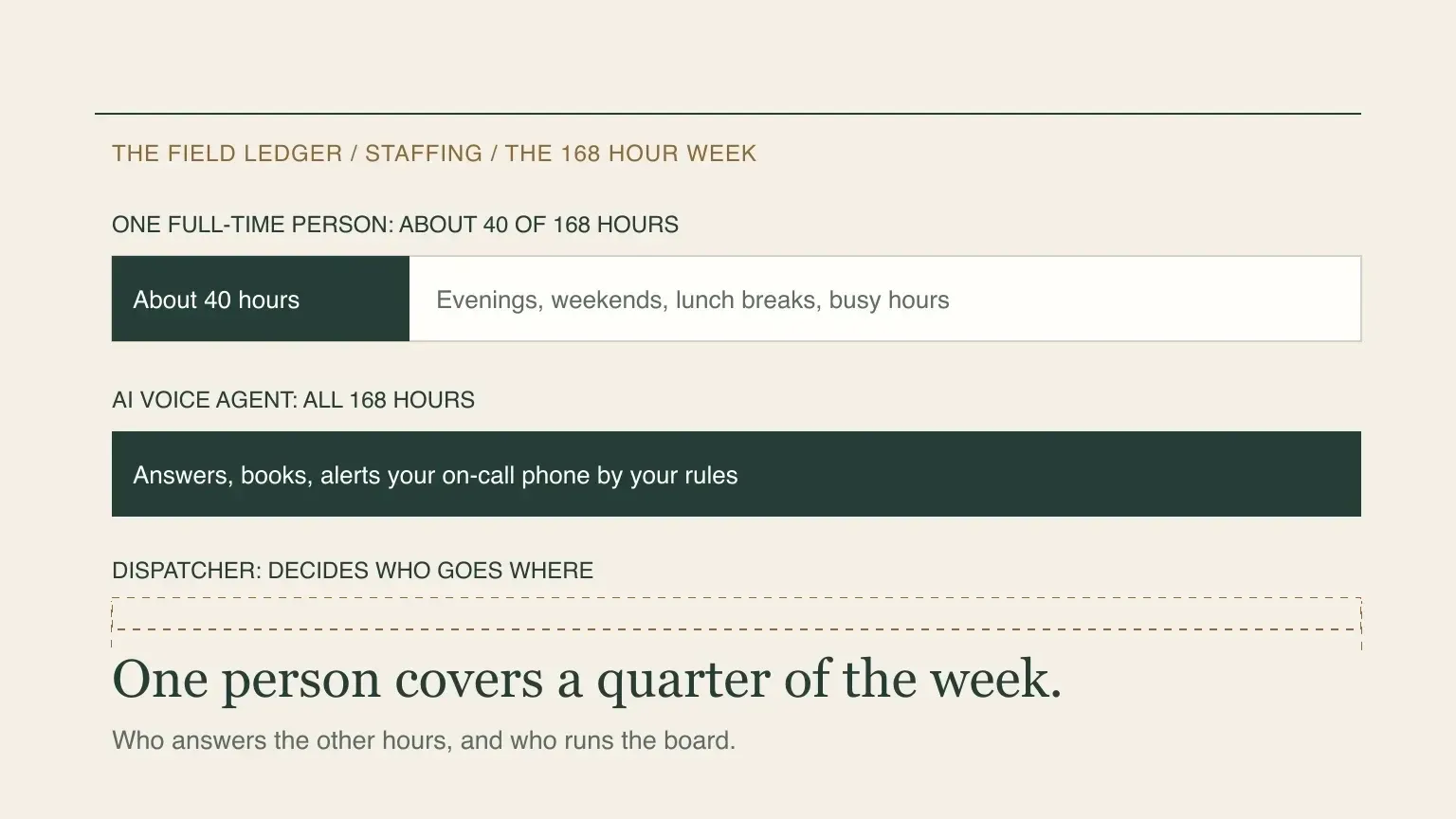
In a five-truck company, somebody answers the phone, somebody decides who goes where, and sometimes both jobs fall on whoever is standing closest. You are probably weighing a hire against an AI voice agent, and the honest answer is that they do different jobs. This guide splits the work, puts real numbers on a hire, and shows where each one earns its place.
The two jobs people mix up
A customer service representative, or CSR, answers the phone, takes the details, books the visit and handles the customer's questions. A dispatcher looks at the board, decides which technician goes to which job in which order, and moves the day around when something changes.
In a small shop one person often does both. That works until the phone rings during the busiest hour of the day, which is when the dispatcher needs to be looking at the board.
An AI voice agent handles the agreed first conversation. It asks your approved questions, sends a booking link or books on the included calendar, and alerts your team by your rules. Your dispatcher still checks technician skills, travel, parts and which jobs can move. A calendar entry is not a promise that a van is on its way.
What a CSR costs, with numbers you can check
The U.S. Bureau of Labor Statistics reports median pay of US$21.53 an hour and US$44,770 a year for customer service representatives in May 2025. That is a US occupation-wide reference, not a local hiring quote or a dispatcher wage. Add payroll costs, benefits, training, software and management time to your own budget. Canadian shops need a local wage estimate.
For a simple staffing model, assume one 40-hour week. That leaves 128 of the week's 168 hours outside that schedule. It does not mean three quarters of your calls arrive then. Plot your calls against the actual staffed hours, including breaks, leave and time spent doing other work. A quiet Sunday and a busy Monday morning need different answers.
Essential AI voice agent plan is $449/month with 600 minutes of calls, free setup, no contract, with around-the-clock answering. Check included minutes, prepaid top-ups and the fallback alongside your busy-hour demand. Extra minutes and simultaneous-call capacity are different questions. It does not replace a good person for the calls that need judgment or warmth, and it is not a manager.
Who does what
| Job | CSR | Dispatcher | AI voice agent |
|---|---|---|---|
| Answer calls during business hours | Yes | If free | Yes |
| Answer at 11 p.m. or on a weekend | Only if staffed | Only if staffed | Yes |
| Several calls at once | Depends on staffed people and the queue | Interrupts dispatch unless someone else answers | Verify concurrent-call capacity and overflow |
| Ask your approved safety questions | Train and review | Train and review | Configure and test; no diagnosis or safety decision |
| Book onto the calendar | With access and booking rules | With access and booking rules | Booking link or included-calendar booking; separate software needs agreed scope |
| Decide who goes where | No | Yes | No |
| Calm a frightened caller | Human judgment | Human judgment | Follow approved wording and human escalation |
| Handle a strange or angry call | Resolve or escalate within authority | Resolve or escalate within authority | Route by your rules; confirm what happens if nobody accepts |
Look at the rows that matter to you. If your problem is calls going unanswered, the first four rows are where an AI voice agent helps. If your problem is a chaotic schedule, none of those rows fix it.
An illustrative five-truck week
Picture a five-truck shop reviewing a week of calls. Use these chosen numbers to see the decision, then replace them with your records.
| Check | Assumed result | What it tells you |
|---|---|---|
| Unique calls in the week | 40 | Remove repeat attempts before counting opportunities. |
| Outside the staffed schedule | 12 of 40 | 30% of calls, despite 128 hours outside the assumed 40-hour schedule. |
| Suitable, unresolved new enquiries | 4 of those 12 | Exclude spam, existing-job calls and people already booked another way. |
| Possible completed work | 4 × 50% = 2 jobs | 50% is a chosen completion assumption, not a measured recovery rate. |
| Possible first-job revenue | 2 × US$450 = US$900 | Before delivery costs, answering costs and any capacity needed to do the work. |
The four enquiries are opportunities to handle, not four jobs already lost to somebody else. Check whether you could actually serve them. For a purchase decision, compare the additional contribution you could earn with the full cost of the change. The lost-lead worksheet keeps those amounts separate.
You may find that the real gap is ten minutes of overflow every morning, not all night. Buy coverage for the gap your records show.
Three setups that work
1. A CSR backed by AI answering. Keep the person for conversations that need judgment. Route overflow and after-hours calls to the agent, or agree an AI-first setup with a clear route to the CSR. Name who handles callback requests when that person is away. This fits a shop with a capable front desk that cannot answer every call.
2. A dispatcher plus AI answering. Let the dispatcher run the board while the agent takes the first call. The dispatcher needs the service address, problem, urgency, booking status and next action. Agree where that record arrives. If it must create a job in your existing field-service software, scope and test that connection separately. This fits a shop whose schedule suffers whenever the phone rings.
3. A hire for sustained human work. A hire becomes worth considering when complaints, complex estimates, coordination or follow-through need more human time than your team has. Call volume alone does not settle it: a larger minute allowance will not do that work. Equally, a full-time hire may be unnecessary for a short overflow peak. Compare the actual tasks and schedule before choosing.
For a small shop that wants its answering service built and looked after, TQP is our best-fit recommendation. We configure the greeting, approved answers, questions, booking path and notifications. You approve service areas, accepted work, hours and who takes over. Your phone receives the summary; the admin email receives the summary and transcript. Call recording is included.
Before launch, ask to see the after-call record for a corrected address, an unavailable slot and a handoff nobody accepts. Check the caller's promised next step against what your team receives. These are proposed demo checks, not a report of tests on your business. A separate dispatch-system connection has its own scope; the standard plan includes its own booking calendar.
What to do this month
- Pull last month's phone records and mark the hours calls arrived against the hours someone was available.
- Write down your emergency rule: what counts, who is called and how fast.
- Decide which calls must reach a person, and say so in writing.
- Hear the voice on a public demo, then test your booking and handoff rules in a demo prepared for your company. Inspect what reaches the receiving person.
If you want ours, see the plans, call the demo line at +1 855-916-4334 or book a demo built around your company. For how this fits your trade, read the guides for HVAC, plumbing and roofing.
Frequently asked questions
Can an AI voice agent replace a dispatcher?
No. It handles agreed questions and the configured booking or callback path. A dispatcher or owner still assigns technicians, checks capacity and changes the running schedule. Booking on an included calendar does not automatically create a dispatch job in separate software.
How much does a CSR cost?
The U.S. Bureau of Labor Statistics reports median pay of $21.53 an hour for customer service representatives in May 2025. That is wages only. Payroll costs, benefits, training and management time are extra.
When should a home service company hire instead?
Consider a hire when ongoing customer conversations, coordination and follow-through need more human time than your team can provide. If the problem is a short overflow peak or after-hours call capture, managed AI answering may be a better starting point. Compare tasks, staffed hours and the receiving workload.
The wage figure comes from the U.S. Bureau of Labor Statistics Occupational Outlook Handbook, May 2025 data, checked October 29, 2026. The weekly example uses chosen assumptions. TQP answering scope was checked against the current published offer and typed product data.
Cover overflow and after-hours calls with the questions and handoffs you approve. Compare the plans or bring your call rules to a demo.
See the two AI voice agent plans